
Web3 UX Writer Jobs: A Career Guide to Content Design in Crypto (2026)
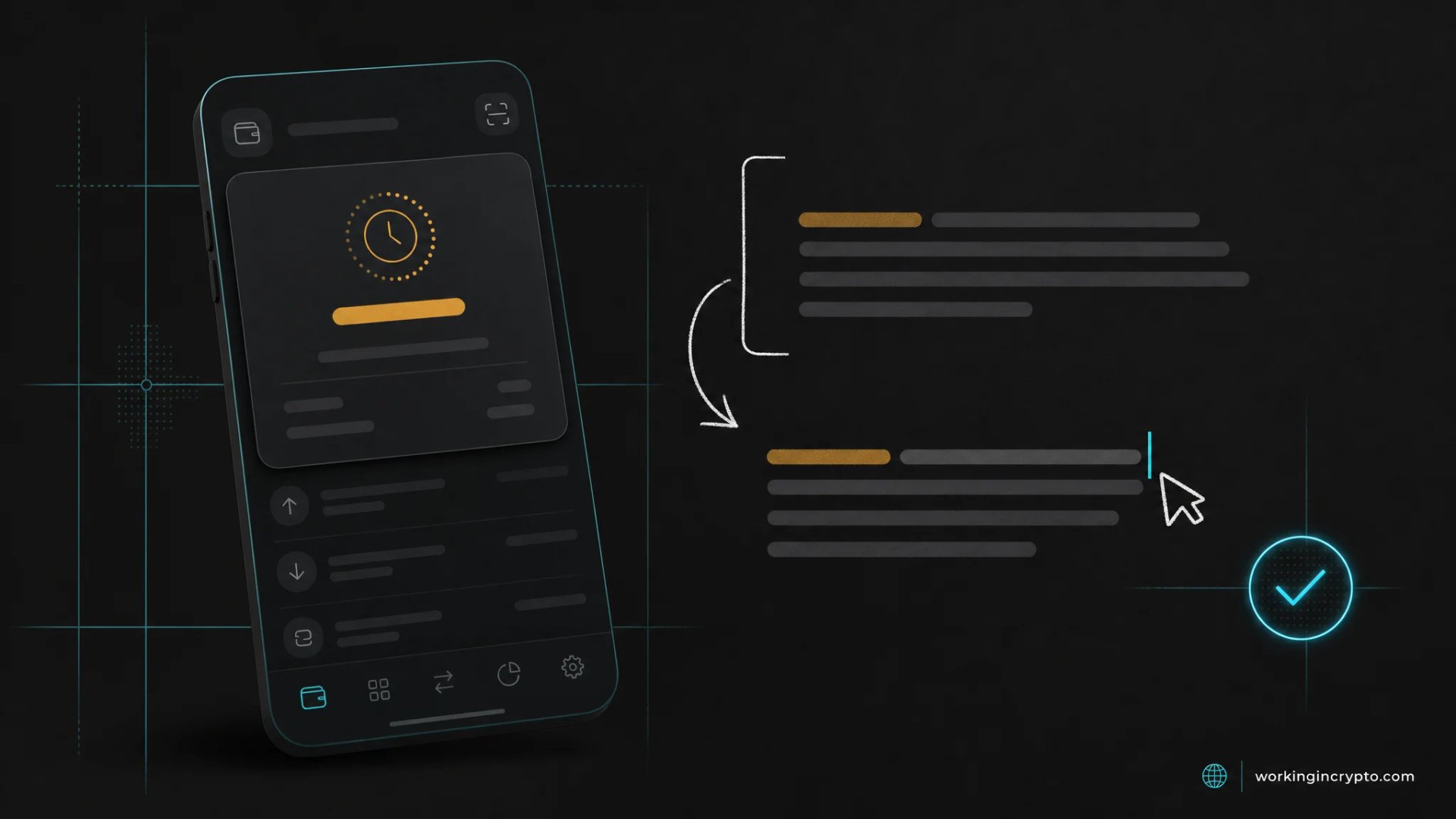
Web3 UX writer jobs are one of the least crowded ways into crypto for someone who writes for a living. Every wallet, exchange and DeFi app has a moment where a person is about to move money they cannot get back, and a few words on the screen decide whether they do it correctly. At many companies those words are still written by an engineer or a marketer working against a release deadline. This guide covers what the role involves, what public pay data does and does not tell you, how to build a portfolio, and how employers should hire for it.
What is a Web3 UX writer?
A Web3 UX writer, often titled content designer, writes and structures the words inside a crypto product: buttons, error messages, transaction states, onboarding flows, warnings and help articles. The job is closer to design than to marketing. A UX writer decides what a screen says when a transaction stalls, what a user is told before signing, and which single term the whole product uses for the same idea.
Content designer is the broader title. It adds research, information architecture and content systems to the writing. A marketing copywriter, by contrast, writes for campaigns and landing pages under advertising rules, which is a different craft covered by Regulated Crypto Copywriting. Both are valid crypto careers. They are not the same job.
Why crypto needs the role more than most software
Crypto removes the safety nets that conventional software takes for granted. Four problems come up repeatedly in the public writing on the subject.
- Irreversibility. A fintech content guide from UX Writing Hub argues that an error message should first confirm whether money moved, for example by stating that the account has not been charged, before explaining what went wrong. It also recommends precise language about finality, such as the difference between a transfer that was "initiated" and one that has "arrived".
- Inconsistent vocabulary. An article on blockchain content design at uxcontent.com counts about eight different names for a single concept, the seed phrase, and recommends standardizing on one plain term, "secret recovery phrase", which says both that it is secret and what it is for.
- Slow and unpredictable transactions. The same article notes that transactions can take minutes, stall or time out, and that fees move with network demand. Writers have to explain pending, slow, canceled and timed-out states, and surface fee choices in plain words.
- Hazardous alerts. The article walks through a real wallet alert that mixed up funds and one specific token, used unexplained jargon and described risk vaguely. Its suggested fix is a clear headline, plain body text, a single action and an FAQ for people who want detail.
Layer regulation on top. The UX Writing Hub guide recommends involving legal reviewers early, through wireframe workshops and a shared library of pre-approved phrases, rather than facing a late rejection loop. In crypto, where compliance copy for KYC and risk warnings is unavoidable, that skill is part of the job.
What the work looks like day to day
Most Web3 content designers spend their week on a mix of these tasks:
- Writing and revising flows: onboarding, send and receive, swaps, staking, recovery.
- Building a state matrix for each transaction, so every pending, failed or reversed case has agreed wording.
- Owning the product glossary and retiring competing terms.
- Auditing strings across web, mobile and help content for inconsistency.
- Reviewing sensitive copy with legal and compliance before it ships.
- Testing wording with users and with support data, such as which error screens generate tickets.
- Working inside the design system so that wording rules ship with components. Our concept note on Design System Governance covers why that matters.
What does a Web3 UX writer earn?
Here is the honest answer: there is no reliable public salary dataset specific to crypto UX writers. Aggregators lump the role in with marketing or technical writing, and crypto pay surveys rarely break it out.
The closest public reference is the 2026 Content Design Salary Report from UX Writing Hub, published in February 2026. It reports median base salaries for full-time content designers of about $55,000 for juniors, $78,000 for mid-level, $98,000 for seniors and $120,000 for leads outside the US, against $82,000, $115,000, $165,000 and $195,000 in the US. Treat those numbers carefully. The article gives no sample size, is written by the operator of a paid course, contains internal inconsistencies elsewhere, and does not cover crypto at all.
Use it as a rough frame, then ask for real ranges. If you are a candidate, request the base range and any token or equity component separately; our guide to token compensation in Web3 jobs explains why those should be valued apart from cash. If you are an employer, publish the range in the posting. Pay-range disclosure is becoming a legal requirement in a growing number of places, and it also filters for candidates who will not waste your time.
How to break into Web3 UX writing
The role draws from several directions, and each has an angle.
- From fintech or banking content design. You already know how to write about money without causing panic. Your gap is crypto vocabulary and irreversibility. Spend a month using wallets and exchanges and note every moment you hesitated.
- From technical writing. You are good at precision. Practice shortening: a transaction screen has a few lines, not a few pages.
- From marketing copy. You know voice and persuasion. Learn the opposite discipline, which is restraint, because a UX writer earns trust by not overselling.
Whatever your route, build a portfolio that shows decisions rather than just finished copy. Four pieces are enough:
- A before-and-after rewrite of a real wallet or exchange flow, with a short note on what you changed and why.
- An error-state matrix for one transaction type that states, in every case, whether funds moved.
- A glossary decision record, for example how you would choose between competing terms for the same concept and what you would test.
- A compliance-aware example, such as how you would explain a KYC request in plain language and still keep the legally required wording.
You do not need to work for a crypto company to produce these. Public products are fair game as long as you label the work as an unsolicited exercise and do not present it as official.
Skills that make a candidate stand out
Plain language about finality, so users always know what has and has not happened. Terminology governance, meaning you can settle a naming fight and keep it settled. Comfort working with lawyers rather than around them. Basic research methods, since the best evidence for wording is user testing and support tickets. Familiarity with design systems and with how strings live in code. And careful use of AI drafting tools: they speed up first drafts, but every line that touches funds still needs a human who understands the consequences.
How employers should hire a content designer
A few moves separate a useful hire from a decorative one.
- Place the role in product, not only marketing. Sitting next to designers and engineers is where the writing changes outcomes.
- Test with a real task. Ask candidates to rewrite a failed-transaction message for a specific scenario and explain what the user should believe about their money afterwards. You will learn more from this than from a portfolio of landing pages.
- Give the writer a legal path. A shared library of pre-approved phrases and an early review slot save weeks.
- Name the work accurately. Posting a "copywriter" role for product content attracts the wrong applicants. Say content designer or UX writer, and describe the flows involved.
- Publish the pay range and say whether tokens or equity are extra.
A company that employs a content designer, keeps a glossary and audits its strings is showing a level of product maturity that is easy to read from the outside. We discuss other signals in our piece on Web3 product design maturity.
FAQ
What does a Web3 UX writer do?
A Web3 UX writer writes and organizes the text inside a crypto product, including onboarding, transaction states, warnings and errors, and keeps terminology consistent. They work with designers, engineers and compliance.
Do I need to understand blockchain to become a Web3 UX writer?
You need working knowledge of how wallets, transactions, fees and recovery phrases behave, because you write about them. You do not need to code. Using products and reading how transactions are explained is a practical way to learn.
How much do crypto UX writers make?
No reliable crypto-specific public data was found. A 2026 content design salary report from UX Writing Hub gives general medians of about $55,000 to $120,000 outside the US and $82,000 to $195,000 in the US depending on seniority, but it is unverified and not crypto-specific. Ask employers for the base range and any token component.
How is a UX writer different from a crypto copywriter?
A UX writer writes the words inside the product and designs how content works. A copywriter writes marketing material under advertising and promotion rules. Some people do both, but the skills and the review processes differ.
What should a Web3 UX writing portfolio include?
Flow rewrites with reasoning, an error-state matrix that says whether funds moved, a glossary decision and a compliance-aware example. Show your decisions and how you would test them.
AI Disclosure: Created with AI assistance (using Vibemyway).
Sources
- UX Writing Hub: Content Design Salary Report 2026 (published 12 February 2026; no sample size given, treat as indicative)
- UX Writing Hub: Fintech UX Writing and Content Design (published 15 February 2026)
- uxcontent.com: Better Blockchain Content Design (originally 2021, updated 2026)
New jobs every day on Telegram
Join the Working In Crypto channel for a daily job digest and a weekly market report. No noise.