
Crypto Sales OTE Explained: How Base, Variable and Token Pay Fit Together (2026)
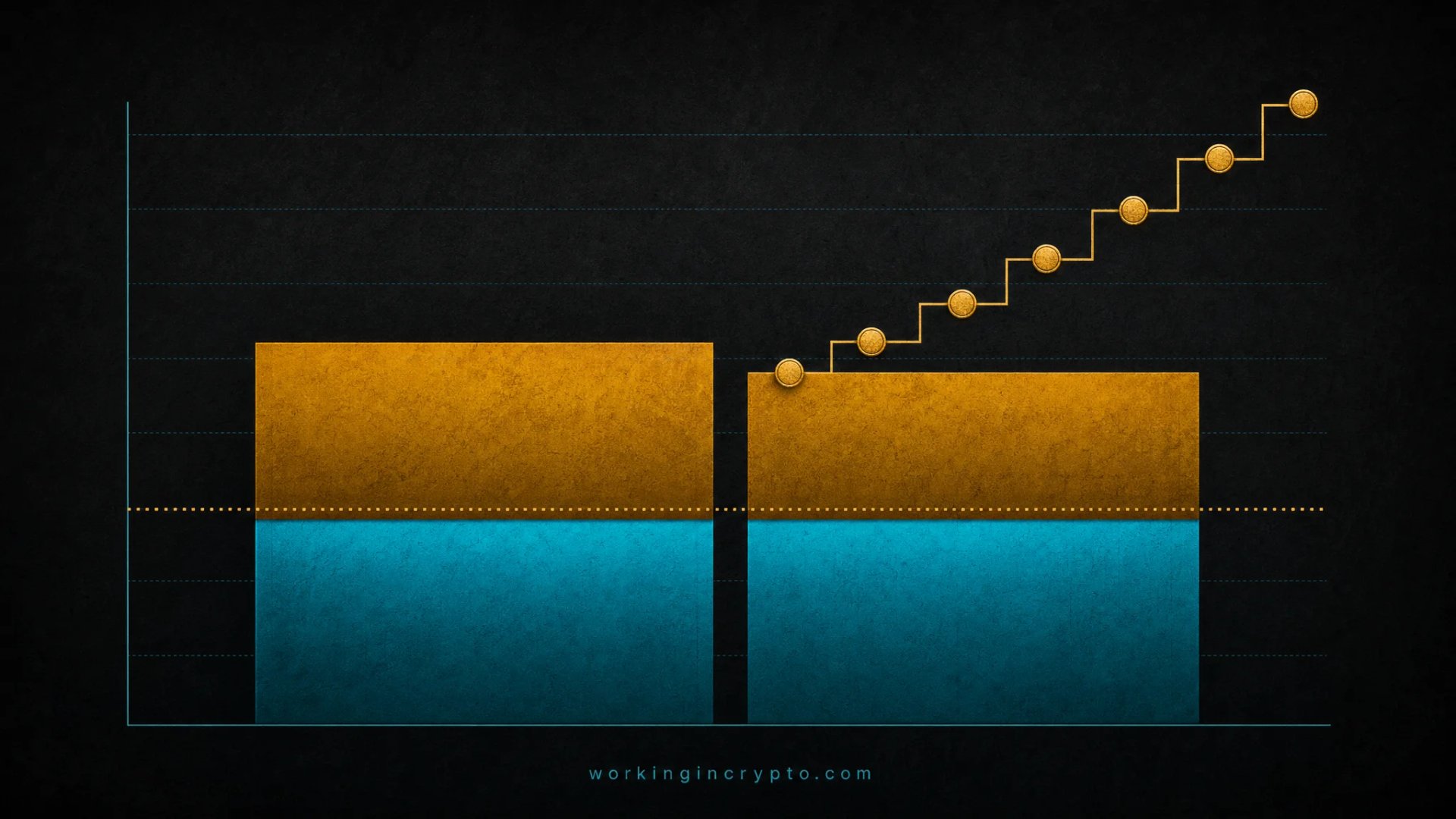
Crypto sales OTE is the number that sits at the top of most sales offers, and it is also the number most likely to mislead you. OTE stands for on-target earnings: base salary plus the variable pay you would earn if you hit your target exactly. It is a plan, not a paycheck. This guide is company-agnostic and written for sales candidates and the employers who hire them. It is general information, not financial or legal advice, and the benchmark figures come from secondary sources that are mostly SaaS-based, so treat them as a reference frame rather than a crypto price list.
What is crypto sales OTE?
Crypto sales OTE is the total cash a salesperson at a crypto company earns in a year if they reach 100% of their quota. It has two parts. Base is paid regardless of results. Variable, usually commission or a bonus tied to closed deals, is paid only when the numbers come in.
Crypto adds a third layer that SaaS mostly does not: tokens or equity. Those are normally separate from OTE, which is why two offers with the same headline can be worth very different amounts. We will come back to that below.
How the base-to-variable split works
The split tells you how much of your income is a bet on your own performance. Commission Cruncher's August 2026 benchmark roundup, which draws on Bridge Group and other sources, lists typical splits by role: SDR or BDR roles at 60/40 to 70/30, inside account executives at 55/45 to 50/50, field or enterprise account executives at 50/50, sales managers at 65/35 to 70/30, and solutions engineers at 70/30 to 75/25. Bridge Group's 2024 figure for SaaS account executives was 53/47.
Read that as a rule of thumb. The closer a role is to closing a deal, the more of the pay is variable. A pre-sales engineer who supports the deal carries less risk than the person whose name is on the quota. If you are weighing a move from an engineering or customer-success job into sales, the lower variable share on technical sales roles is worth knowing about. Our piece on crypto salary benchmarks by seniority shows where base pay for non-sales roles sits for comparison.
The quota math behind the headline number
OTE only means something next to the quota it depends on. Two ratios matter.
The first is OTE-to-quota. Commission Cruncher reports a median of 4.2x for SaaS account executives, citing Bridge Group 2024, with an example of a $190,000 OTE against a quota of roughly $800,000. Repwing's August 2026 roundup cites Qobra for a 4x to 6x range. The second is the implied commission rate. Bridge Group's 2024 median, as reported by Commission Cruncher, was 11.5% of annual contract value at 100% attainment, with a typical range of 11% to 14%.
Here is the arithmetic on that example. A $190,000 OTE at a 50/50 split is $95,000 base and $95,000 variable. Divide $95,000 by an $800,000 quota and you get about 11.9%. Now the part candidates skip: attainment. If you reach 50% of quota and the plan is purely linear, with no floor and no accelerator, variable drops to about $47,500 and total cash to about $142,500. That is an illustration, not a quote from any plan, but it shows why the quota size matters more than the OTE line.
The attainment numbers are sobering. RepVue data cited by Repwing puts account executive quota attainment at 40.6%. Fullcast's 2026 enterprise benchmark cites its own 2025 H1 report saying 76.6% of sellers missed quota in the last year. The older Alexander Group 2023 figures reported by Commission Cruncher are kinder: 49% of core sellers reached quota and average aggregate attainment was 89%. These sources use different samples and definitions, so do not average them. The point is that a plan where most reps miss target is a plan where realized pay sits below OTE.
What the data says about crypto sales pay
Public crypto-specific numbers are thin, and the ones that exist rarely separate base from OTE.
SailOnchain, a salary aggregator, lists an average crypto sales range of $172,785 to $208,551 a year, based on 61 active listings and anonymous candidate reports, last updated 18 November 2026. It says the figures reflect cash compensation only, but does not say whether that means base or OTE, and it shows a minimum of $20,000 that looks like an outlier.
Crypto Recruit's March 2026 salary article, based on its own placements, covers business development and partnerships rather than quota-carrying sales. It gives a base range of $110,000 to $190,000, with $135,000 plus variable as the most common shape, and notes annual bonuses of 10% to 25% of base and signing bonuses between $10,000 and $100,000. It describes the commission layer as often heavy but gives no rates or quotas.
For a SaaS reference frame, Repwing's roundup cites Optymyze for a median SaaS account executive OTE of about $195,000 at a 50/50 mix, and RepVue for an enterprise median OTE of $275,000. Fullcast puts enterprise base at $130,000 to $150,000 and OTE at $260,000 to $300,000. These are not crypto figures. They are useful because many crypto infrastructure and custody sellers are hired from, and benchmarked against, enterprise software. If a crypto offer lands far below the SaaS range for the same segment, ask why.
Where tokens and equity sit next to OTE
Do not add token value to OTE. Treat it as a separate, uncertain line. Crypto Recruit reports that pre-launch protocols commonly grant 0.1% to 0.5% of total supply with four-year vesting and a one-year cliff, valued at $0 at the time of the offer. Established protocols are quoted at $50,000 to $500,000 over four years, subject to market moves. Exchange and infrastructure companies tend to offer equity plus tokens with, in its words, lower upside and lower risk. The author's own view is that token compensation is marketing, which is a fair warning to ask for the actual terms.
For a sales role, the questions are specific. Is the token grant tied to quota or guaranteed? Does it vest on time or on performance? What happens to unvested tokens if you are let go? Our guide to token compensation in Web3 jobs goes deeper on why the split matters.
Five questions to ask before accepting a sales offer
- What is the quota, and how was it set? Ask for the number, the territory or account list, and the period it covers.
- What share of reps hit quota last year? A seller who gets a straight answer here is dealing with a team that tracks it. Silence tells you something too.
- Is there a ramp or guarantee? New hires usually need months to build a pipeline. Ask whether variable pay is guaranteed during that period and for how long.
- Are there accelerators, caps or clawbacks? Commission Cruncher's source article gives no figures for any of them, so there is no market norm to point to. Get the plan document and read it.
- Which part of the offer is token or equity, and what are the exact terms? Separate it from cash in your own comparison.
What employers should publish
If you are hiring, the plain move is to state base, target variable and the OTE in the posting, and to say whether tokens or equity are extra. Pay-range disclosure is becoming a legal requirement in a growing number of places, and candidates for sales roles are used to doing the math. Our guide to writing a crypto job description covers how to present pay ranges and token terms without scaring off the right people. A seller who sees an OTE with no base, no quota and no token terms will assume the worst, and the best ones will not apply.
FAQ
What does OTE mean in crypto sales?
OTE means on-target earnings: base salary plus the variable pay you earn if you hit 100% of quota. It excludes tokens and equity unless the employer says otherwise.
What is a typical base-to-variable split for a crypto account executive?
There is no crypto-specific published norm. SaaS benchmarks put enterprise and field account executives at about 50/50, and some crypto employers copy that structure. Ask for the plan in writing.
Is crypto sales OTE higher than SaaS sales OTE?
The available data does not settle it. SailOnchain's crypto sales average of roughly $173,000 to $209,000 sits near the SaaS median of about $195,000 reported by Repwing, but the crypto figure does not say whether it is base or OTE.
Should I count tokens as part of my OTE?
No. Keep token and equity grants as a separate line, value them conservatively, and ask about vesting, cliffs and what happens if you leave.
What quota attainment should I expect?
Published figures vary widely, from 40.6% for account executives (RepVue via Repwing) to 49% of sellers reaching quota (Alexander Group 2023). Ask the employer for its own recent number.
AI Disclosure: Created with AI assistance (using Vibemyway).
Sources
- Repwing: Account executive OTE and quota benchmarks 2026 (published 7 August 2026, compiles Optymyze, RepVue, Qobra, Bridge Group)
- Commission Cruncher: Sales commission structures benchmarked, OTE pay mix and quota ratios for 2026 (10 August 2026, cites Bridge Group 2024 and Alexander Group 2023)
- Fullcast: Enterprise AE compensation benchmarks (published 29 January 2026)
- SailOnchain: Crypto sales salaries (last updated 18 November 2026)
- Crypto Recruit: Crypto salaries in 2026 (11 March 2026)
New jobs every day on Telegram
Join the Working In Crypto channel for a daily job digest and a weekly market report. No noise.