
CeDeFi: The Product Category That Just Became Impossible to Ignore
CeDeFi: The Product Category That Just Became Impossible to Ignore
Here's what nobody's talking about: CeDeFi stopped being a whitepaper concept and became a hiring category — and it happened in a single week.
The week of June 30, 2026, two of the most consequential companies in their respective parts of the crypto stack each posted senior PM roles and used the word "CeDeFi" in the job description. Not in a blog post. Not in a conference keynote. In the actual work they are paying $200k-plus to get done.
Robinhood. OP Labs. Different business models, different user bases, completely different positions in the stack — and both landed on the same vocabulary to describe where they're going.
That kind of vocabulary convergence doesn't happen by accident. When two independent companies, working separately, reach for the same term to describe what their next senior hire will own, the term is ready. The category is real. The only question is whether you're paying attention.
What Is CeDeFi?
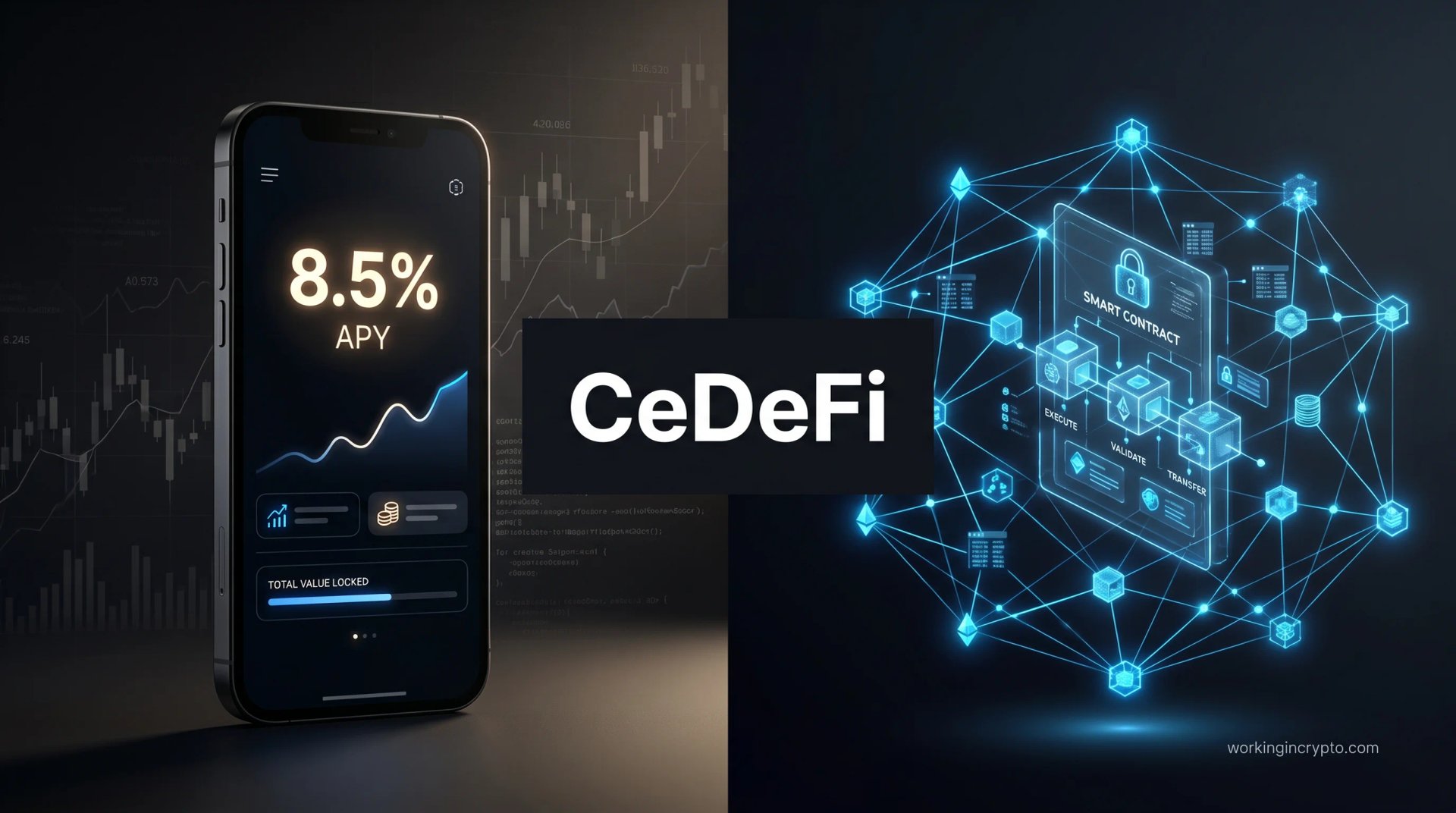
CeDeFi (Centralized Decentralized Finance) is a hybrid product category that combines the compliance structures and user experience of centralized finance with the yield mechanisms, transparency, and settlement efficiency of decentralized finance. In plain terms: users interact through a familiar, custodied interface — no wallet management, no gas fees, no private key anxiety — while their capital is deployed into on-chain lending protocols, liquidity pools, or staking infrastructure on the backend.
It's not a compromise. It's an architecture decision. CeDeFi is what you build when you want to offer real DeFi returns to people who will never, ever manage a hardware wallet.
Three layers define how it works. First, a regulated custodial front-end where users hold balances and execute transactions through an interface that looks and feels like existing financial apps. Second, a compliance middleware layer that handles transaction monitoring, regulatory reporting, and the batching of user activity into on-chain operations that satisfy both the regulator and the protocol. Third, the on-chain DeFi layer itself — AMMs, lending protocols, liquid staking — where the actual yield or liquidity function happens.
The middle layer is where almost all the engineering complexity lives. And it's why CeDeFi PM roles pay at the top of the market.
Why Robinhood and OP Labs Are Building This at the Same Time
The short answer: because now they actually can.
Three macro conditions have aligned in 2026 to make CeDeFi viable at scale in a way it wasn't two or three years ago.
Regulatory clarity arrived. MiCA cleared the path in Europe. U.S. frameworks around stablecoins and crypto trading products have become navigable enough that large regulated companies are willing to commit product roadmaps — not just research initiatives. Compliance is still hard. But it's no longer unknowable.
Infrastructure matured. Layer 2 networks like the Optimism Superchain have scaled to the point where enterprise-grade throughput and settlement security are table stakes, not aspirational. ERC-4337 account abstraction makes it possible to build non-custodial interfaces that feel custodial to the user. Stablecoin rails — USDC, USDG, PYUSD — give CeDeFi products the settlement layer they need. The plumbing is there.
Institutional demand hit a wall. Over 75% of institutional investors planned to expand digital asset exposure by 2026, but the raw DeFi stack was never built for them. Sophisticated capital needs auditable custody, transaction monitoring, and regulatory reporting. CeDeFi is the product architecture that makes DeFi yields accessible to institutions without requiring those institutions to become crypto-native.
Robinhood's path is direct-to-consumer. They launched Robinhood Chain on public mainnet in July 2026, bringing tokenized stock trading to 120+ countries alongside Robinhood Earn — a decentralized lending product offering roughly 7% APY on USDG through self-custody wallets. The user experience is unmistakably Robinhood. The settlement layer is unmistakably on-chain. That's the product.
OP Labs' path runs through infrastructure. Their OP Enterprise offering, launched in January 2026, is purpose-built for fintechs, centralized exchanges, and payment companies who want to offer on-chain products without running their own chain. The Sr. PM role posted in late June isn't about building CeDeFi for end users — it's about building the rails that regulated financial companies sit on top of when they build their own CeDeFi products. The Superchain currently supports $6.1 billion in total value locked across 50+ live chains. The PM OP Labs is hiring will accelerate that institutional adoption.
Two different product strategies, one category name. Both are real.
What the Compensation Signals Say
Product managers in crypto have always commanded a premium. But Robinhood's $217k–$255k range for this specific role is a different kind of signal than the general crypto PM market.
That's not startup salary with a token allocation to bridge the gap. That's full cash compensation at Wall Street PE analyst territory — the kind of number Goldman Sachs or Citadel pays senior product people on their trading technology teams. When a company structures comp that way, it's competing for talent from TradFi and winning on cash, not on upside. It's a statement about how seriously they're taking the product.
The salary range also clarifies the talent profile they're chasing. This isn't a crypto-native PM who's been living in DeFi for five years. This is someone who understands financial products regulation, user trust dynamics in retail investing, and the technical complexity of on-chain settlement — simultaneously. That person commands real money because they're genuinely rare.
For PMs sitting in fintech or financial services evaluating whether to move to crypto: the compensation gap that once made the jump feel risky is gone. The skills that make you valuable in traditional fintech — product thinking around compliance, user experience for financial applications, working with legal and risk teams on regulated product features — are exactly the skills CeDeFi companies are now paying top dollar to hire.
The PM Role That Didn't Exist Two Years Ago
Here's what I find most interesting about this moment: the CeDeFi PM role is genuinely new.
You can't hire it from traditional DeFi. DeFi protocol PMs are used to permissionless systems, governance token dynamics, and users who manage their own keys. That's a completely different operating model from a CeDeFi product that has to pass compliance review, run KYC/AML on every user, and deliver a seamless experience to people who don't know what gas is.
You can't hire it from traditional fintech either. A great PM at a payments company or a neobank knows how to ship regulated financial products, but they don't understand how to architect a system that routes user capital through on-chain lending protocols while maintaining regulatory reporting obligations in real time.
The CeDeFi PM lives at the intersection — and that intersection has only existed at scale for about twelve months. The people who got here early, who saw the convergence coming and built fluency in both domains, are commanding significant premiums right now.
CeDeFi and the Web3 Career Opportunity in 2026
The broader implication of the week of June 30 isn't just about two job postings. It's about what those postings signal for the career landscape in Web3 over the next 18 to 24 months.
CeDeFi as a named product category means that product, engineering, compliance, and design roles organized around CeDeFi are going to proliferate. Robinhood has shipped a CeDeFi product and will need to staff the team around it. OP Labs is selling CeDeFi infrastructure to fintech companies who will in turn need their own PM talent to build on top of it. Every major retail brokerage that's watching Robinhood Earn closely is running an internal conversation right now about whether they need a CeDeFi roadmap.
That creates opportunity. The people who understand the product architecture — the three-layer model of custodial UX, compliance middleware, and on-chain execution — and can speak fluently to compliance, engineering, and user experience teams are going to be very well compensated for the foreseeable future.
The roles won't all be called "CeDeFi PM." They'll be called Crypto Product Manager, Senior PM Crypto Trading, PM Fintechs and Exchanges. But the underlying work will be the same: making DeFi accessible through compliant, custodied wrappers that work for users who have never managed a wallet in their lives. The category is real. The hiring is starting. The question is whether you're positioned for it.
Frequently Asked Questions
What is CeDeFi and how is it different from DeFi?
CeDeFi (Centralized Decentralized Finance) combines the user experience and compliance structures of centralized finance with the on-chain yield mechanisms of DeFi. Unlike pure DeFi — where users manage their own wallets, pay gas fees, and interact directly with smart contracts — CeDeFi products provide a custodied interface and handle compliance on the user's behalf, while still routing capital through DeFi protocols on the backend. The result is DeFi-level yields accessible through a traditional financial app experience.
How does CeDeFi differ from CeFi (centralized finance)?
CeFi platforms (like traditional crypto exchanges or banks) hold user funds in off-chain custody and manage investments through internal systems. CeDeFi platforms route user funds through on-chain DeFi protocols — lending, liquidity provision, staking — while maintaining the custodied interface and compliance wrapper of a centralized service. The key difference is that CeDeFi yield comes from real on-chain activity, not from the platform's internal balance sheet.
What companies are building CeDeFi products in 2026?
Robinhood is the highest-profile example, having launched Robinhood Earn — a decentralized lending product offering roughly 7% APY on USDG — in July 2026. OP Labs is building the infrastructure layer that regulated financial companies use to offer CeDeFi products through the Superchain. Other notable participants include BounceBit (CeDeFi V2), OKX, and Unizen (the highest-funded CeDeFi exchange at $200M as of early 2026).
What skills does a CeDeFi product manager need?
A CeDeFi PM needs fluency in three domains simultaneously: regulated financial product development (KYC/AML, compliance review, regulatory reporting), blockchain product architecture (smart contract interaction, L2 infrastructure, on-chain settlement dynamics), and consumer product thinking (UX for non-crypto-native users, trust signals, financial app design patterns). The rare intersection of these three skill sets is exactly what commands $200k-plus compensation at Robinhood and OP Labs.
Is CeDeFi a good career opportunity for fintech professionals?
Yes — the timing is unusually good. The CeDeFi PM role is new enough that it doesn't require years of crypto-native experience, but established enough that companies are paying serious cash (not token-heavy packages). Fintech professionals with regulated product experience, payment systems, or retail investing platforms have the compliance and product intuition that crypto-native PMs often lack. Layering on DeFi mechanics and L2 infrastructure knowledge is the gap to close — and it's smaller than it used to be.
Conclusion
CeDeFi is not a trend. It's not a buzzword. It's a product architecture that has matured to the point where the largest retail brokerage in the United States and the most ambitious L2 infrastructure company in crypto are both naming it in their PM job descriptions in the same week — and paying over $200k to hire the people who can build it.
The infrastructure is ready. The regulatory environment is navigable. The talent market is beginning to organize around the category. For product professionals at the intersection of fintech and crypto, for engineers who've been watching from the sidelines, for investors tracking where the next round of product hiring will concentrate — this is the signal you were waiting for.
The category is real. The jobs are here. The window for early movers is open right now.
Browse open Web3 PM roles on Working In Crypto — including the CeDeFi and fintech-adjacent roles shaping this market.