
Candidate Fraud in Remote Crypto Hiring: Deepfake Interviews and How to Verify Who You Hire
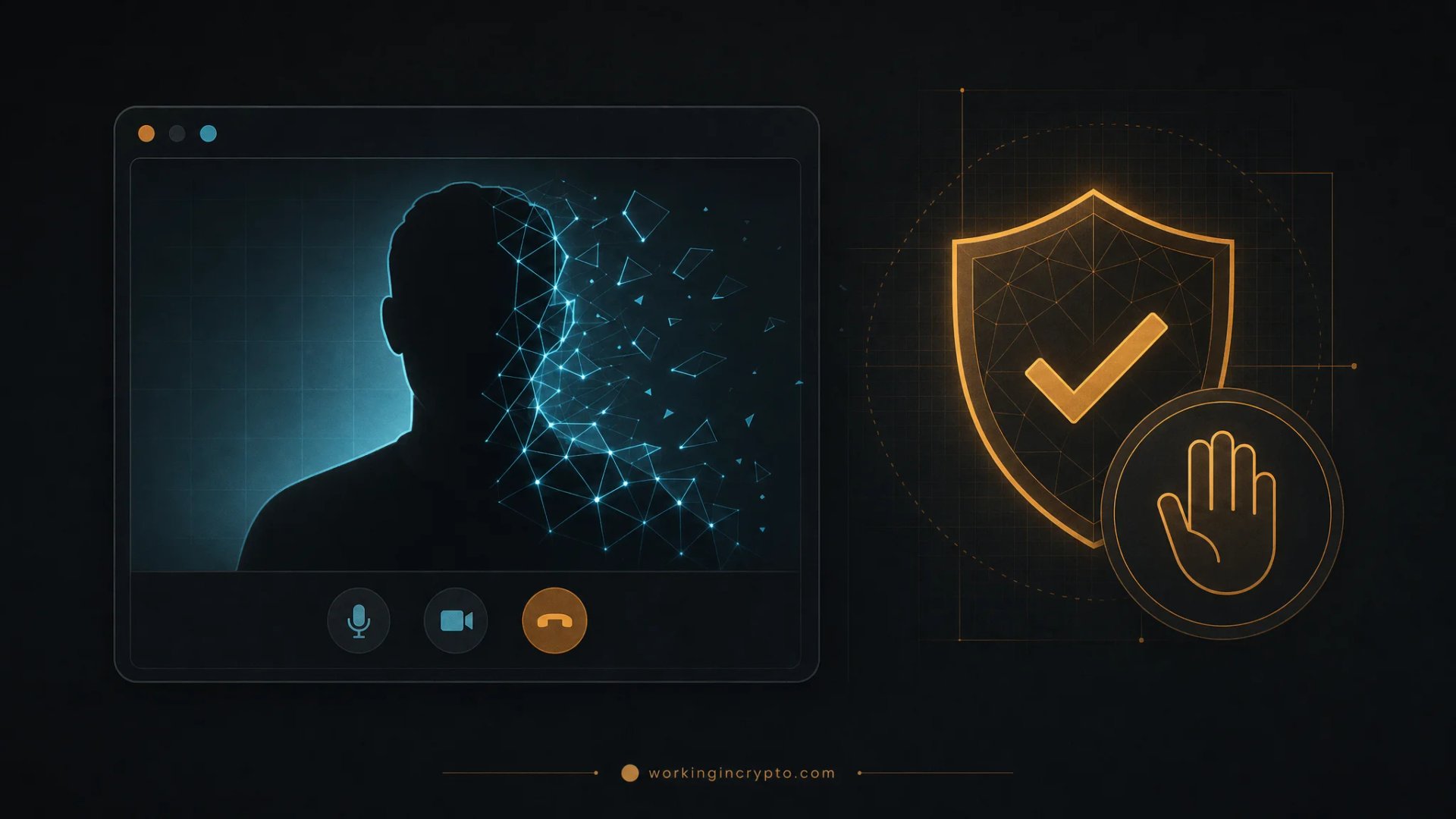
What Is Candidate Fraud in Remote Hiring?
Candidate fraud in remote hiring is any attempt to get hired, or to get paid, by misrepresenting who you are or what you can do. It runs from padded résumés and AI-written take-home tests to proxy interviews, where someone else answers the questions, and full identity fraud, where a person uses a stolen or fabricated identity to pass checks and start work.
Crypto companies sit near the top of the target list. Teams are distributed, hiring is fast, pay is high, and many roles come with access to code repositories, signing infrastructure or customer funds. A fake hire in a bakery steals a few shifts. A fake hire with commit rights to a wallet codebase is a different problem.
This guide is for the people running the hiring process. It covers what the data says, the three kinds of fraud worth separating, a verification flow that does not insult honest candidates, and the day-one controls that catch what interviews miss. It is general information, not legal advice. Identity checks and monitoring are regulated differently in each country, so run your final process past counsel.
Why Crypto Hiring Is a Target
Three features make the sector attractive to fraudsters. First, remote-first is the default, so nobody expects a candidate to show up at an office. Second, compensation is strong and often paid in ways that are hard to trace, including stablecoins. Third, the work itself touches assets: private keys, deployment pipelines, admin dashboards, internal tooling.
The security research points the same way. A Cloud Security Alliance research note published in August 2026 says crypto startups have dominated earlier reporting on North Korean IT worker schemes. The same note describes a researcher-run honeypot, a fake DeFi startup with a branded site, job postings and a full interview process, which drew three applicants who were hired into monitored sandbox machines. Treat that as one team's experiment, not a market statistic. Still, it shows how easily a plausible crypto employer attracts this kind of applicant.
What the Data Says
Numbers on this topic are thin and mostly come from vendors and analysts, so read them with care.
- Gartner has predicted that by 2028, one in four candidate profiles worldwide will be fake, as reported by Personnel Today. That is a forecast, not a measurement.
- In a Gartner survey of roughly 3,000 candidates, 6% admitted to interview fraud, either posing as someone else or having someone pose as them. The coverage does not give the survey date, so use the figure as an indicator only.
- The FBI has warned about fake remote IT workers since 2022 and issued further guidance since. In early January 2025 the US Justice Department announced indictments in a scheme that affected 64 companies, according to ITPro's report of the FBI guidance.
- The CSA note cites an eleven-nation joint advisory dated 31 July 2026 that put funds sent to North Korean weapons programs at roughly $800 million in 2024. It also reports that a convicted US laptop-farm operator hosted more than 90 corporate laptops and defrauded over 300 companies of more than $17 million. Check the primary advisory before quoting these figures yourself.
The honest reading: nobody knows the true rate, but the trend and the tooling are moving in one direction. Real-time face-swap software is cheap, and AI answers generated during a live call are hard to spot.
Three Kinds of Candidate Fraud
Different frauds need different defences, so separate them.
Misrepresentation. Inflated titles, invented projects, copied code samples, AI-written work-trial answers. This is the oldest kind and the most common. A structured, skills-based interview and a short live exercise handle most of it.
Proxy and deepfake interviewing. The person on the call is not the person who will do the job. Either a stand-in answers the technical questions, or a face and voice are altered in real time. The Deepfake Interview Fraud pattern is hard to catch with a single video call because the call is where the deception lives.
Identity fraud and state-linked infiltration. A fabricated or stolen identity, a clean-looking set of documents, and a plan to start work and move money or data. The FBI guidance describes DPRK IT Worker Infiltration and the red flags that follow it: multiple logins to one account from different countries within a short time, unapproved remote desktop tools, copying code repositories to personal accounts, and software that runs several calls at once.
A Verification Flow That Respects Candidates
You do not need to turn every interview into an interrogation. A layered flow keeps friction low for most people and concentrates effort where risk is highest.
- Screen the application. Look for identical résumé text or contact details across different applicants, which the FBI lists as a hiring signal. Check that the work history, location and time zones tell one story.
- Run one live, unscripted step. Ask the candidate to move a hand across their face or hold up an object during the call. The CSA note says current face-swapping tools still render these gestures imperfectly. Pair it with open-ended questions about location, education and the town they say they live in.
- Test the skill live. A short pairing session or whiteboard problem where you change the constraints mid-way is much harder to fake than a take-home. Watch for long pauses, eyes tracking a second screen, and answers that sound polished but cannot survive a follow-up.
- Verify identity before the offer is final. Use a document check and a liveness check from a reputable provider, or a short in-person or notarised verification where it is lawful and practical. Compare the name on the ID, the bank account and the contract. Mismatches, such as a driver's licence from one state with a home address in another and a bank account in a third, were among the flags in the CSA honeypot.
- Consider one in-person moment. Gartner's advice includes in-person interviews as an anti-cheating safeguard, and its survey found 62% of candidates said they would be more likely to apply if in-person interviews were required. For a senior role with key access, a one-day meet-up or a local co-working session can be worth the travel.
Document what you do and apply it to every finalist for the same role. Selective checks invite bias and discrimination claims.
Day-One Controls That Catch What Interviews Miss
Even a good interview process will let someone through eventually. Treat the first weeks as part of the control.
- Least privilege. Start new hires without production access, signing rights or admin tools. The FBI guidance recommends disabling local administrator accounts and limiting who can install remote desktop software.
- Sandboxed probation. The CSA principle is "observe before you trust". Give new engineers a monitored environment first, then expand access as they pass milestones. See Probationary Sandbox Onboarding.
- Ship hardware directly. Send company laptops to the verified home address and ask for a short unboxing call. Be suspicious of last-minute address changes.
- Watch behaviour, not people. Alert on multiple logins from different countries, unapproved remote tools, bulk repository cloning and data moved to personal cloud accounts. Gartner frames the goal as system-level validation rather than individual surveillance.
- Audit your vendors. Staffing agencies and subcontractors can hide the real worker behind a clean contract. Ask them to describe their verification and audit it.
Before turning on monitoring, check notice and consent rules in each country where employees sit. Rules differ widely, and in some places a hidden tool is a legal problem of its own.
What If You Suspect a Fake Hire?
Pause access first, then investigate. Preserve logs and the interview recordings you are allowed to keep. The CSA note advises talking to sanctions counsel before continuing wage payments to a suspected operative, and reporting confirmed or suspected cases to the FBI through IC3.gov if you are a US-connected employer. Outside the US, contact your national cyber or law-enforcement reporting channel. Do not confront the individual before legal and security have agreed a plan.
What Honest Candidates Can Do
For candidates the shift mostly means a few extra steps. Expect a live exercise, an ID check and possibly a camera-on onboarding call. Use a stable connection, turn off virtual backgrounds and filters, and say so if you rely on assistive tools. If a recruiter asks for sensitive documents by email or chat, confirm the request through the company's official careers page first, since scammers also impersonate employers. A clear, calm answer to "where are you based?" is a better signal of honesty than any polish.
What Changes for Employers in 2027
Expect identity verification to become a standard stage in the funnel, much like background checks became standard in finance. Expect applicant tracking systems to add fraud flags. Expect candidates to ask what you verify and how you protect the documents they upload. The firms that treat this as a trust-building process, with plain explanations, will keep their application rates up while the careless ones absorb the losses.
Frequently Asked Questions
How common are deepfake job interviews?
There is no reliable census. Gartner predicts that one in four candidate profiles will be fake by 2028, and a Gartner survey of around 3,000 candidates found 6% admitting to interview fraud. Treat both as indicators, not exact rates.
How can I tell if a candidate is using a deepfake on video?
No single tell is conclusive. Ask for an unscripted gesture such as moving a hand across the face, watch for lag between audio and lips, and compare the live session with a second verified touchpoint. Security researchers say current tools still struggle with occlusion, but that will change.
Are crypto companies really targeted by fake IT workers?
Reporting and research notes describe crypto startups as frequent targets of North Korean IT worker schemes, and the FBI has issued repeated advisories since 2022. Any company that hires remote engineers with access to code or funds should assume it is a target.
Is identity verification of job candidates legal?
Generally yes when done with notice, a lawful purpose and appropriate data protection, but rules vary by country, especially for biometric data. Check local law before using liveness or face-matching tools.
What should we do on a new hire's first day?
Grant minimal access, ship company hardware to the verified address, run the work in a monitored environment, and review logs for remote-access tools or unusual logins during the first weeks.
Sources and External Links
- Personnel Today: By 2028 one in four candidate profiles will be fake (Gartner survey coverage): https://www.personneltoday.com/hr/by-2028-one-in-four-candidate-profiles-will-be-fake
- ITPro: FBI issues guidance for enterprises as fake North Korean IT workers wreak havoc (28 January 2025): https://itpro.com/security/fbi-issues-guidance-for-enterprises-as-fake-north-korean-it-workers-wreak-havoc
- Cloud Security Alliance Labs: DPRK IT Worker Infiltration, how sandboxed honeypots exposed the hiring-pipeline threat (August 2026): https://labs.cloudsecurityalliance.org/research/csa-research-note-dprk-it-worker-infiltration-sandbox-202608/
- FBI Internet Crime Complaint Center: https://www.ic3.gov
Figures from secondary coverage are reported as published and should be checked against the primary sources before reuse. This article is general information and not legal advice.
AI Disclosure: Created with AI assistance (using Vibemyway).
New jobs every day on Telegram
Join the Working In Crypto channel for a daily job digest and a weekly market report. No noise.