
AI GTM Engineer: The $190K Web3 Role That Didn't Exist Two Years Ago
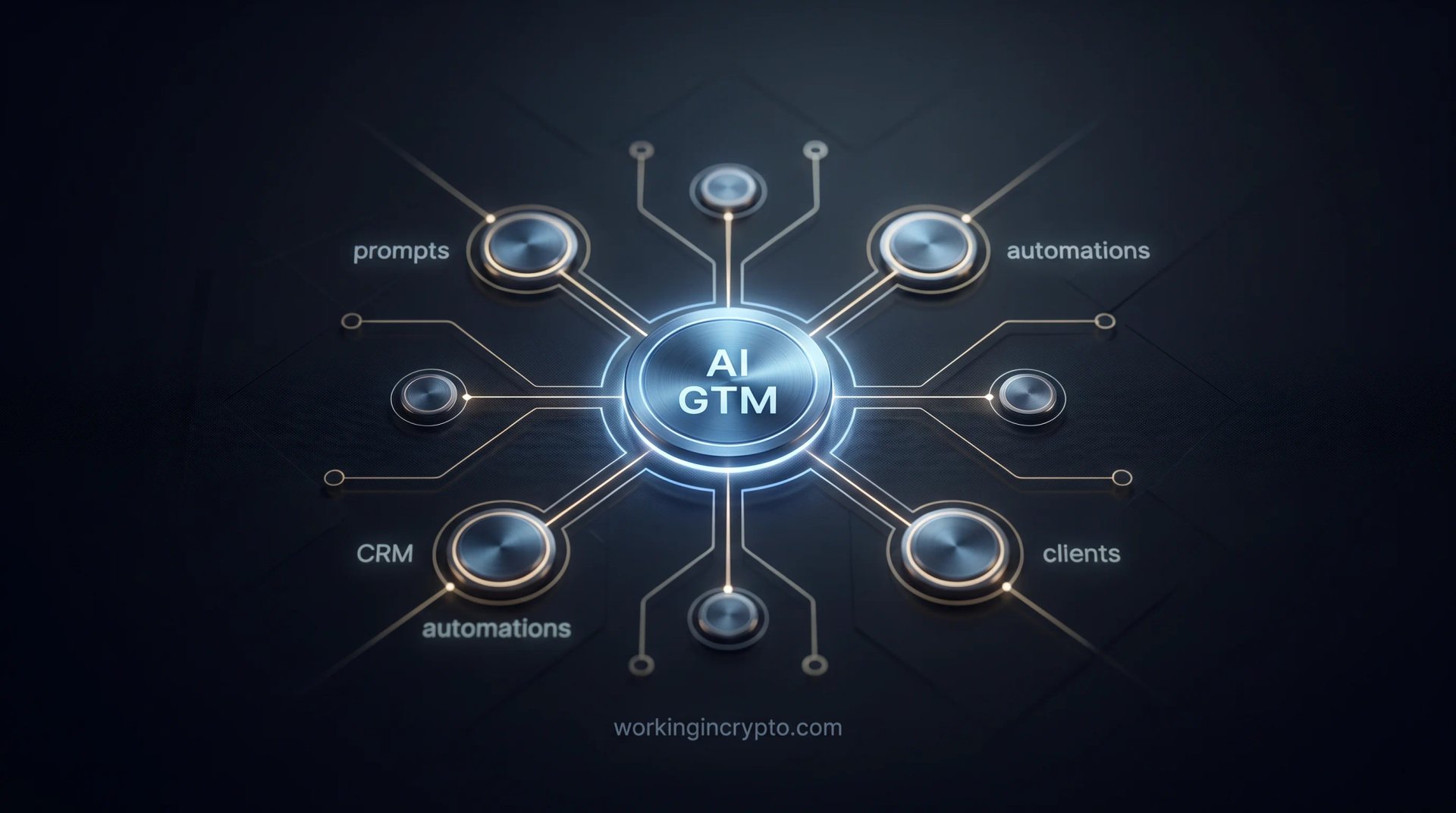
Something is shifting in how web3 companies build their marketing functions. For the past few years, every serious protocol announced an "AI team" — a dedicated group of engineers and researchers tasked with figuring out what AI means for the business. That structure is quietly collapsing. Not because AI matters less, but because it matters everywhere now. The AI team is dissolving into every team.
Nowhere is this shift more visible than in a job title you probably haven't heard before: the AI GTM Engineer. Serotonin, a 90-person go-to-market agency that serves 300+ web3 clients, posted this role in June 2026 and priced it at $80,000 to $190,000 — a band wide enough to hire a senior engineer or an exceptionally sharp mid-level candidate, whichever they find first. The range itself tells you something. When you can't anchor salary to a comparable role, you don't try. You just post the whole range and let the market sort it out.
Here's what the AI GTM engineer is, why web3 is building this role first, and what it means for anyone thinking about their career in this space.
What Is an AI GTM Engineer?
An AI GTM engineer is a specialist who builds AI-powered systems inside a company's go-to-market function — not using AI as a productivity shortcut, but rebuilding how GTM work actually gets done, from the workflow layer up.
The job sits at an unusual intersection. You need the marketing judgment to know which GTM processes are worth automating. You need the LLM engineering chops to build prompt libraries, fine-tune outputs, and chain models together into durable workflows. And you need the automation engineering skills to connect all of it — LLM outputs flowing into CRM systems, campaign analytics tools, client-facing dashboards — through platforms like Make, Zapier, and n8n.
At Serotonin specifically, the scope goes further: the AI GTM Engineer is also an internal enablement lead. They are expected to train the whole agency team on the AI tools they build, then productize those workflows across the agency's entire client base. This is not a solo builder role. It's a function-creating role. The person they hire won't join an existing AI GTM team — they'll be building the concept of what that team is.
Why Web3 Is Building This Role First
Most industries are talking about AI-augmented marketing. Web3 is actually hiring for it. The gap between talk and action in this sector has always been smaller than elsewhere — partly because the talent is more technically fluent, partly because the client base is comfortable with tooling that looks half-finished, and partly because agencies like Serotonin are under pressure to deliver results at a pace that only automation can sustain.
The web3 GTM context adds specific urgency. A protocol launch has a short window. Community-building is high-velocity, high-volume work. Content demands are relentless. Research on competitors and sentiment is ongoing. None of this scales through headcount alone, which is why agencies with 90 people are serving 300+ clients. The AI layer isn't just nice to have — it's the math that makes the business model work at that ratio.
What Serotonin is doing isn't unique. It's just the first public job posting to make the function explicit with a real salary attached. Other web3 agencies and marketing teams are building similar capabilities. The difference is that Serotonin named the role and priced it.
What the Job Actually Requires
The Serotonin listing breaks down into four distinct skill areas, each of which maps to a different professional background:
1. LLM prompt engineering and library design. The AI GTM Engineer builds and maintains the firm's prompt infrastructure — not just one-off prompts for content generation, but structured libraries that produce consistent, brand-aligned outputs at scale. This requires both LLM technical understanding and deep familiarity with what good GTM content looks like.
2. No-code automation engineering. Make, Zapier, and n8n are the glue that connects LLM outputs to real workflows. The AI GTM Engineer must be comfortable building these automations from scratch, handling error states, and maintaining them as tools evolve. This is more like a junior DevOps skillset applied to no-code tooling than it is like a marketing tech skill.
3. Client-facing AI workflow design. This is the agency-specific layer. The AI GTM Engineer isn't building internal tools for one company — they're building workflows that get deployed to clients. That means understanding different clients' brand voices, data environments, and regulatory constraints, then adapting AI systems accordingly. It's product thinking applied to marketing automation.
4. Internal training and change management. This is often missing from AI job descriptions, which tend to focus on the build. At Serotonin, training the team is explicit in the scope. The AI GTM Engineer is also an educator — responsible for driving adoption of tools they build, which requires communication skills that pure engineering roles don't emphasize.
No single career path prepares you for all four. The current market for this role skews toward people who came up through marketing ops or growth engineering and taught themselves LLM fundamentals — not ML researchers who pivoted to GTM. The former group understands the problem well enough to build the right solution. The latter often overengineers it.
The Comp Reality: What $80K to $190K Actually Signals
A salary band that spans $110,000 is not indecision. It's a market signal. When a company posts a band that wide, they're saying: we don't know what experience level will show up in the market for this function, so we've priced for the full range. The floor is enough to attract a solid mid-level candidate with the right skill mix. The ceiling is enough to attract someone who's already done a version of this job somewhere.
What's notable is where the ceiling lands. $190,000 puts the senior AI GTM Engineer in the same compensation territory as a senior full-stack engineer at a mid-stage startup. That's a meaningful signal about how Serotonin — and by extension, the web3 GTM market — is valuing this function. They're not treating it as a marketing ops upgrade. They're treating it as a technical leadership role.
For candidates thinking about this as a career path: the floor ($80K) is likely where someone lands with strong GTM background plus demonstrated LLM skills but no automation engineering depth. The ceiling ($190K) is likely reserved for someone who has shipped production-grade AI workflow systems at scale. There's a big middle tier where most hires will land, probably in the $110–$140K range for someone with two to three years of directly applicable experience.
How to Get There from Different Starting Points
If you're coming from traditional GTM or marketing ops: your domain knowledge is the hard-to-teach part. Focus on learning LLM fundamentals (prompt engineering, basic API integration), then pick one no-code automation platform deeply (Make is the most powerful for complex flows). Build something real — an actual client workflow or internal automation — and document it. That's your portfolio.
If you're coming from software engineering: you already have the automation and integration skills. Your gap is GTM domain knowledge and the particular product thinking required for client-facing AI workflow design. Spend time understanding how marketing agencies actually operate: what their clients care about, what the high-friction points in a content or campaign workflow look like, and why marketing leadership makes the decisions they do. The best hires will be able to walk into a client meeting and understand the problem before designing the solution.
If you're coming from AI research or ML engineering: the technical ceiling is high, but the role isn't optimized for it. Most AI GTM work doesn't require deep model knowledge — it requires reliable prompt systems and stable integrations. If research is your background, the most valuable pivot point is learning to build with existing models rather than building models themselves. Focus on the no-code automation layer, which is counterintuitively not intuitive for engineers.
The Broader Signal
Serotonin's hire is not an isolated data point. Look across web3 this week: Ondo Finance is hiring a security engineer who must also build LLM-assisted alert triage. OKX is hiring a platform architect to govern production-grade multi-agent systems. In each case, the AI skills aren't in the job title — they're embedded in the requirements of roles that already existed.
The AI team isn't being eliminated. It's being dissolved into every team. The GTM team now needs an AI layer. The SecOps team needs an AI layer. The platform engineering team needs an AI layer. The people who build those layers will have hybrid skill sets that no traditional career path fully prepares you for.
That's uncomfortable for hiring managers trying to benchmark comp and write job descriptions. It's an opportunity for anyone willing to build across the boundary of their existing expertise.
The AI GTM Engineer is one of the first roles to make this hybrid explicit with a real salary attached. It won't be the last.
Frequently Asked Questions
What does an AI GTM engineer actually do day-to-day?
An AI GTM engineer builds and maintains automated marketing workflows powered by LLMs. Day-to-day, that means writing and testing prompt libraries for content production, configuring no-code automations in tools like Make or Zapier that move LLM outputs into CRM or analytics platforms, troubleshooting integrations that break when APIs update, and working with the broader GTM team to identify new processes worth automating. At agencies, it also includes deploying these workflows across client accounts and training teams on how to use them.
Is the AI GTM engineer role specific to web3?
Web3 is where this specific job title is emerging, but the underlying function — embedding AI into marketing operations — is appearing in other industries too. Web3 companies are hiring for it more explicitly and earlier, partly because the technical talent density is higher and partly because the pace of the market demands automation-heavy workflows. Expect the role to appear in broader tech, fintech, and media contexts over the next 12–18 months.
What skills are most important for an AI GTM engineer?
Based on the Serotonin listing and similar emerging roles, the core skill set is: LLM prompt engineering (not ML training — working with existing models), no-code automation platforms (Make, Zapier, n8n), GTM domain knowledge (understanding the marketing funnel, campaign strategy, content workflows), and communication skills for client-facing work and internal training. Programming skills (Python especially) are a strong plus for more complex integrations.
How does the AI GTM engineer role differ from a marketing technologist?
Marketing technologists typically manage and integrate existing marketing software stacks — CRM, analytics, automation platforms, ad tech. The AI GTM engineer's focus is specifically on LLM-powered systems layered on top of those stacks. The distinction is the LLM layer: building prompt infrastructure, maintaining AI workflow systems, and training teams on new AI-native processes rather than configuring existing tools.
What is the salary range for AI GTM engineers in web3?
The most public data point is Serotonin's $80,000–$190,000 range for a remote, global hire. This is a deliberately wide band reflecting how early-stage this function is and the market uncertainty about what experience level will apply. Until more companies post AI GTM Engineer listings with salary data, this is the clearest benchmark available for the web3 market.
Conclusion
The AI GTM Engineer represents something larger than a new job title. It represents the end of AI as a separate department and the beginning of AI as a baseline expectation across every function. Web3 is where this shift is happening first and most visibly, partly because the sector is technically fluent and moves faster than most.
If you're building your career in web3 and you're on the marketing, growth, or operations side of the business, the question isn't whether to develop AI skills — it's which ones, and how fast. The AI GTM Engineer role exists because someone had to build the AI layer in the GTM function. More of those roles are coming, in GTM and every other function.
The $190K ceiling isn't the point. The point is what it signals: this work is hard to find, valued highly when you do find it, and currently wide open.