
Web3 Legal Hiring: What 6 Lawyer Jobs in One Week Tell You About Crypto's Next Phase
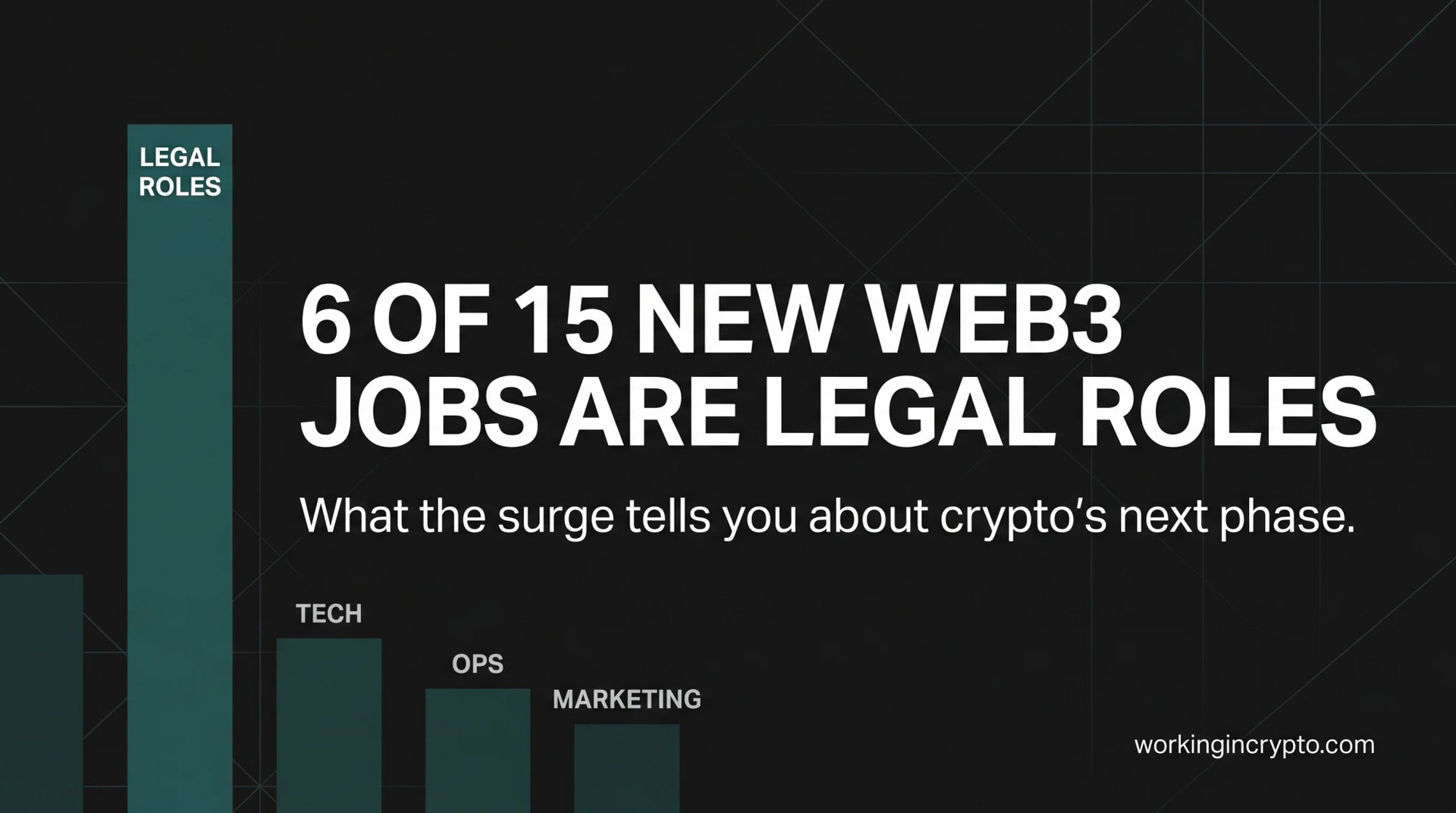
Something shifted in the Web3 job market last week. Of the 15 new crypto roles added to the board, six of them were legal positions. General Counsel, Senior Legal Counsel, Commercial Counsel, Data Protection, Legal Operations Lead, Senior Paralegal — all in a single week, across six different companies.
That's 40% of new postings. In an industry still widely assumed to be a developer's game.
This isn't a fluke, and it isn't coincidence. It's a signal about where the crypto industry is in its maturation arc, and what that means for the kinds of professionals it's starting to need.
What Web3 Legal Hiring Actually Looks Like Right Now
Before reading into the trend, it helps to see the raw data. In the week of June 14, 2026, these legal roles were posted across the market:
- General Counsel — Wormhole Labs (remote)
- Senior Legal Counsel — Lido (remote)
- Senior Counsel, Product and Commercial — Ondo Finance (remote)
- Commercial Counsel — LI.FI (remote)
- Legal Counsel, Data Protection — Bitpanda (remote, Europe)
- Legal Operations Lead — Solana Foundation (remote US)
- Senior Paralegal — Blockdaemon (remote)
Seven roles across seven companies, covering the full legal career spectrum from paralegal to GC. All remote. Spanning DeFi, cross-chain infrastructure, proof-of-stake validators, EU-licensed exchanges, and RWA tokenization platforms.
This is not one company building a department. This is a category moving.
Why Crypto Companies Are Hiring Lawyers Now
The question isn't whether Web3 companies need legal teams. The question is why they're building them at this moment rather than earlier or later.
The answer comes down to a predictable lifecycle that most protocols go through — one that becomes legible when you look at hiring rather than token prices or GitHub commits.
Phase 1: Build the thing. The first 18-30 months of a serious protocol's existence are engineering-heavy. Legal is handled by outside counsel. The company doesn't need a GC because the number of legal events per year doesn't justify the overhead.
Phase 2: Monetize the thing. Once the technology works, growth becomes the problem. BD managers, partnerships leads, and growth marketers become the priority hires. Commercial agreements accumulate. The outside counsel bill starts to grow.
Phase 3: Institutionalize the thing. When regulatory exposure grows too large to manage with external advisors — SEC inquiries, MiCA compliance, cross-border data handling, a volume of commercial contracts that requires in-house judgment — you build the legal team. The best companies do it before they're forced to.
What the June 14 digest reveals is that a significant cohort of Web3 companies are crossing the threshold into Phase 3 at the same time.
Three Cross-Chain Protocols That Prove the Pattern
The clearest evidence comes from three interoperability protocols in the same week.
Wormhole Labs hired a General Counsel. Its core bridge architecture was built out in 2022-2023. The GC hire in mid-2026 fits a three-year engineering to commercial to legal arc precisely.
LI.FI hired a Commercial Counsel. The protocol has live integrations and real volume. Commercial Counsel means they're signing enough agreements at enough complexity that they need dedicated legal judgment, not outside advice.
OP Labs hired a Partnerships Lead for Blockchain Infrastructure. Not engineering. Commercial relationship management for the Optimism Superchain ecosystem.
None of these three companies posted an engineering role in the same week. They all moved from the same phase to the same next phase simultaneously, because the crypto industry matures in cohorts.
The Regulatory Accelerant: What MiCA Is Doing to Hiring Timelines
Protocol maturation explains some of the legal hiring surge. EU regulation explains a meaningful chunk of the rest.
The EU's Markets in Crypto-Assets Regulation (MiCA) began applying to Crypto-Asset Service Providers in December 2024. For exchanges, custodians, and token issuers operating in Europe, MiCA isn't optional — it's an authorization requirement.
MiCA compliance isn't just a policy checkbox. It requires building specific internal functions: data protection officers, compliance monitoring processes, whitepaper documentation, and ongoing regulatory reporting. That's hiring, not consulting.
Bitpanda's Legal Counsel, Data Protection hire is textbook MiCA preparation. Bitpanda is one of the larger EU-licensed crypto exchanges; the role sits at the intersection of MiCA's requirements and GDPR obligations.
Tether hired a People and Culture Analyst in Brussels — consistent with entity establishment for EU regulatory authorization under MiCA.
Lido's Senior Legal Counsel hire reflects a combination of protocol maturation and regulatory monitoring. Its liquid staking product sits in a zone of regulatory ambiguity across multiple jurisdictions.
What This Means for Your Career
If you're a finance lawyer, compliance officer, or legal professional from TradFi who's been watching the crypto space: the lane is open in 2026, and it's wider than it's ever been.
The roles being posted require experience that maps directly from traditional legal practice. General Counsel at a DeFi protocol is not substantively different from GC at a fintech company — the regulatory landscape is different, the product is different, but the function is the same.
The knowledge gap is real but learnable. Crypto attorneys who come from securities law or financial services regulation have the most natural cross-over. Crypto is essentially a new asset class sitting on top of existing legal frameworks — securities law, money transmission, data protection, commercial contract — with protocol-specific complexity layered on top.
The compensation is market-competitive. The GC of a protocol with significant TVL is not taking a pay cut from BigLaw partner track.
The Roles That Are Not Engineering
Across the full June 14 batch: 6 legal roles, 1 Senior Benefits Manager (Chainlink), 1 People and Culture Analyst (Tether), 1 Head of Global Product Marketing (Binance), 1 Partnerships Lead (OP Labs), 1 BD Manager (Fireblocks). That's 11 of 15 new roles that don't require writing code.
The assumption that Web3 is a developers-only space was always an exaggeration. The data is now making that case explicitly.
Frequently Asked Questions
What does a General Counsel do at a crypto company?
A GC at a crypto company oversees all legal risk, manages regulatory relationships, advises the executive team on legal strategy, and runs the in-house legal function. In crypto specifically, the GC manages exposure to securities law, money transmission licensing, AML/KYC obligations, cross-border compliance, and commercial agreements with chains, dApps, and institutional counterparties.
Do you need to know blockchain technology to work in crypto legal?
You don't need to be a developer, but you need enough technical literacy to understand what your clients' products do. Most crypto companies will train legal professionals on the technical context; what they can't teach quickly is legal judgment and regulatory knowledge. The technical learning curve is manageable within six to twelve months for motivated professionals.
Why are Web3 companies hiring lawyers in 2026 specifically?
Three forces converged: the 2021-2022 protocol cohort reaching institutional maturity, MiCA's December 2024 application deadline creating a compliance hiring wave, and ongoing SEC enforcement activity creating demand for proactive regulatory counsel. All three factors are strongest in 2025-2026.
How does crypto legal hiring compare to traditional law firm work?
The pace is faster and the regulatory landscape is less settled. In-house roles at crypto companies involve more business partnership — working closely with product, engineering, and finance on live decisions — than law firm work typically does. Compensation at the GC and Senior Counsel level is comparable to equivalent experience at a US financial services firm or technology company.
Is the legal hiring surge specific to certain types of crypto companies?
The June data covers a broad spread: DeFi protocols, cross-chain infrastructure, EU exchanges, validators, and foundations. What these companies share is scale and regulatory exposure, not a specific product category. Any protocol with significant TVL, EU customers, or institutional relationships is now a candidate for in-house legal investment.
What Comes Next
The legal hiring surge of June 2026 is almost certainly not a one-week anomaly. The forces driving it — protocol maturation timelines, MiCA compliance deadlines, SEC enforcement pressure — are all medium-term dynamics. The cohort crossing the threshold now will continue building legal teams through 2027. Protocols that launched in 2023-2024 will start their own legal buildout in 2027-2028.
For career changers watching the space, the window is open now. The legal roles in Web3 are real, paying competitively, and require skills that exist in traditional finance and law practices. The knowledge gap is smaller than it was two years ago, and the appetite to hire people who can bridge it is clearly there.
When 40% of new postings in a notoriously technical industry are legal roles, it's worth taking the signal seriously. Browse open legal and non-technical Web3 roles at workingincrypto.com — updated weekly.