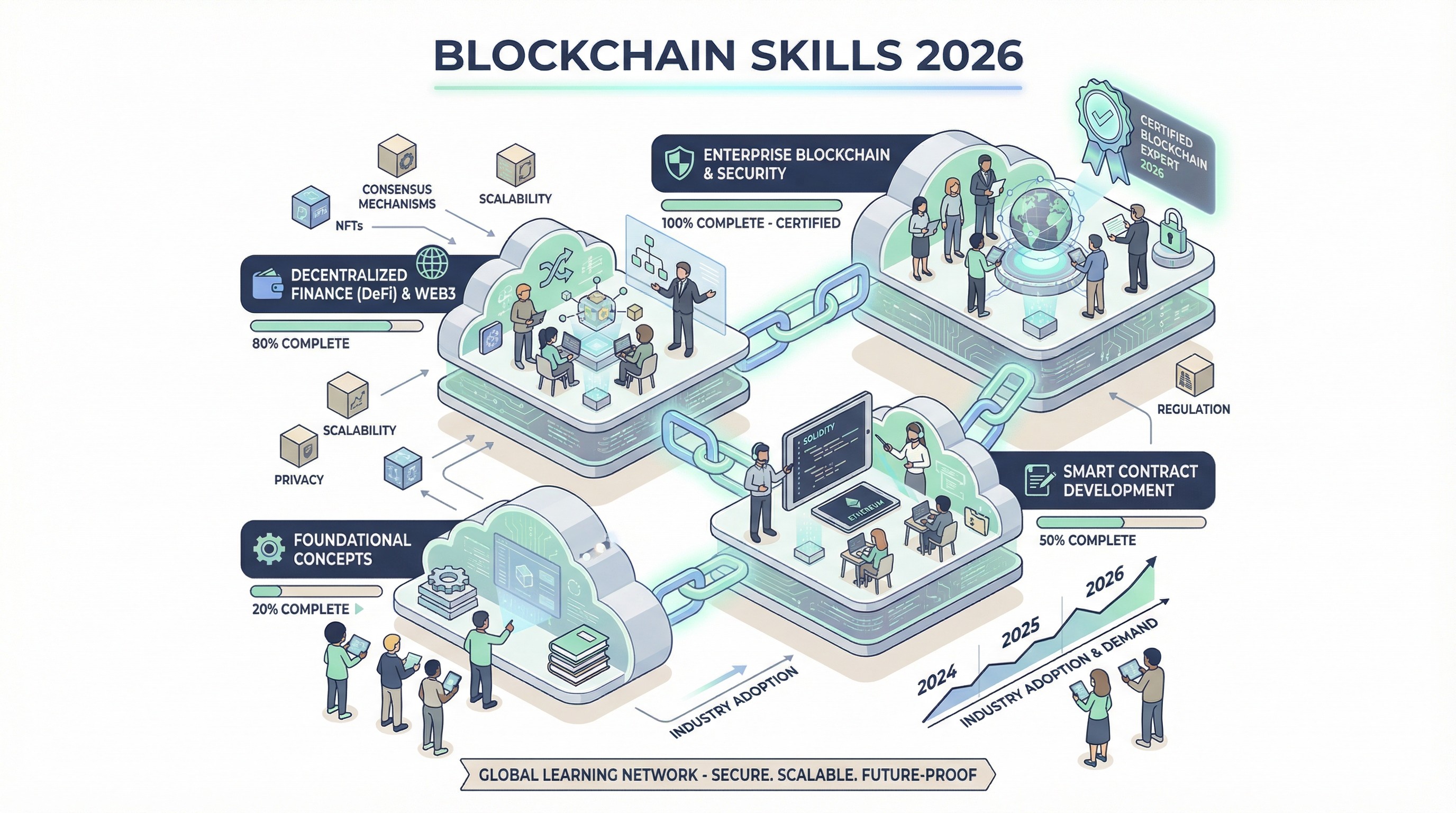
The blockchain landscape is evolving rapidly, and if you're a job seeker looking to break into or advance within this exciting space, you need to stay ahead of the curve. It's Friday, January 30, 2026, and the days of simply knowing Solidity are long gone. The industry demands a broader, deeper skillset. This blog post dives into the top 10 must-learn blockchain skills for 2026 that go beyond basic smart contract development, equipping you with the knowledge to land your dream job and thrive in the Web3 revolution.
The blockchain talent landscape has undergone a fundamental transformation. Once concentrated among blockchain-native startups and cryptocurrency exchanges, the technology has now penetrated traditional financial institutions, enterprise systems, healthcare organizations, and supply chain networks [1][3]. Forget the speculative boom; this is about structural adoption.
According to recent analysis, over 460 full-time Web3 positions were posted on major job boards in January alone [21]. While this represents a contraction from peak 2025 hiring, it signifies market maturation and a focus on sustainable projects. The average compensation for blockchain developers in the United States reached approximately $150,000 annually in early 2026, with experienced professionals commanding significantly higher salaries depending on specialization [21][38].
Let's explore the skills that will make you a highly sought-after candidate in 2026:
1. Smart Contract Auditing (Security Demand Surge)
Smart contract security is no longer an afterthought; it's a critical foundation. The irreversible nature of blockchain transactions means even minor vulnerabilities can lead to catastrophic financial losses [25][58]. The blockchain security market is projected to reach a staggering $37.42 billion by 2029, growing at a compound annual growth rate of 65.5% from $3.01 billion in 2024 [25].
Smart contract auditing involves comprehensive code analysis to identify vulnerabilities, inefficiencies, and potential attack vectors before deployment. This includes formal verification, fuzzing, static analysis, and threat modeling [55][58]. Companies like Veridise are actively recruiting security analysts with proficiency in languages like Rust, Solidity, C/C++, and Go, along with experience in source code security reviews [5].
Actionable Insight: Start learning security best practices for smart contract development. Explore tools like Slither for static analysis and consider contributing to bug bounty programs to gain practical experience.
2. AI + Blockchain Integration (60% Hiring Increase)
The convergence of artificial intelligence and blockchain is creating roles that require hybrid expertise. McKinsey predicted in 2024 that AI integration in blockchain analytics will substantially improve transaction speeds and security while enabling enhanced fraud detection and operational efficiency [6].
AI can analyze vast amounts of on-chain data to identify suspicious transaction patterns, detect market manipulation, and predict token price movements [13]. The emerging role of protocol economists often involves using machine learning models to design tokenomics that prevent common failures [21]. There's also the fascinating application of AI agents managing DAOs, requiring professionals who can design prompt engineering strategies for AI agents that manage DAO treasuries or optimize protocol parameters [16].
Actionable Insight: Explore machine learning courses focused on time-series analysis and anomaly detection. Learn how to apply these techniques to blockchain data using Python libraries like Pandas and Scikit-learn.
3. Rust and Move for Next-Gen Chains
Solidity, while a good starting point, is increasingly recognized as lacking important safety guarantees. Rust and Move are emerging as critical competencies for 2026. Rust, favored for systems-level blockchain development, offers performance and reliability [7][10]. Major tech companies like AWS and Microsoft use Rust for core infrastructure [7].
Rust's ownership model and type system eliminate entire categories of bugs through compile-time guarantees [10][7]. Over 13% of programmers worldwide expressed strong interest in learning or improving their Rust skills by 2024 [10]. Solana's runtime environment is written in Rust, and numerous Layer 2 scaling solutions use it as their primary implementation language [7].
Move, designed specifically for blockchain asset security and smart contract development, powers platforms like Sui and Aptos [26][29]. Move's type system enforces asset security at the language level, preventing common smart contract bugs [29].
Actionable Insight: Begin learning Rust or Move. Rust's official documentation is excellent, and there are numerous online courses available. Explore the Sui and Aptos ecosystems to understand Move's practical applications.
4. On-Chain Data Analytics
The explosion of blockchain data volume has created demand for professionals who can extract actionable insights from immutable transaction records [13][40][56]. Every transaction is permanently recorded and publicly accessible, creating a perfect laboratory for studying economic behavior.
This requires understanding blockchain architecture, querying state at various network layers, interpreting transaction calldata, and tracing value flows [13][40]. You'll also need traditional data science methodologies combined with cryptographic understanding [31][34]. Platforms like Dune Analytics and Nansen provide on-chain data infrastructure.
Actionable Insight: Master SQL for querying blockchain data warehouses and Python for statistical analysis. Learn how to use Dune Analytics or Nansen to explore on-chain data and create insightful dashboards.
5. Regulatory/Compliance Knowledge (MiCA)
The regulatory landscape for blockchain and cryptocurrency is rapidly crystallizing. The European Union's Markets in Crypto-Assets Regulation (MiCA) has established uniform rules for crypto-asset issuers and service providers across the EU [9][12]. Similar initiatives are emerging worldwide [3][9][21].
Compliance officers with cryptocurrency expertise are highly sought after [21]. Crypto firms must navigate complex regulatory frameworks while maintaining operational agility. This includes enhanced reporting mechanisms, surveillance infrastructure, and trained personnel [9]. The most sophisticated operations integrate blockchain analytics and AI-driven compliance solutions [9][25].
Actionable Insight: Stay updated on regulatory developments in your region and globally. Familiarize yourself with MiCA and other relevant regulations. Consider pursuing certifications in compliance and risk management.
6. ZK Proofs Basics
Zero-knowledge proofs (ZKPs) address critical challenges in blockchain systems: enabling privacy-preserving transactions, scaling solutions, proving data validity without revealing underlying information, and facilitating secure cross-chain communication [8][11][30].
A ZKP allows one party to prove knowledge of specific information to another party without revealing the information itself [8][11]. Key properties include completeness, soundness, and zero-knowledge [8][11]. Two primary categories are SNARKs and STARKs [11][39]. ZK-Rollups are a vital scaling solution for Layer 2 networks [8][43].
Actionable Insight: Learn the fundamentals of ZKPs and their applications in blockchain. Explore ZK-Rollup projects like StarkNet and zkSync.
7. Solution Architecture for Enterprise
Blockchain solution architects are in demand as institutions adopt blockchain technology beyond cryptocurrency [19][22][49]. Architects design, build, maintain, and scale solutions for organizations across various industries [22]. They translate business requirements into technical specifications and ensure solutions align with strategic goals [19][22].
This requires in-depth knowledge of blockchain architecture, distributed ledger technology, consensus algorithms, security mechanisms, and cryptography [19][49]. According to Glassdoor, blockchain architects earn an average annual base salary of $140,232, with total compensation reaching $182,145 [22].
Actionable Insight: Gain experience as a blockchain developer and gradually transition to architectural roles. Focus on understanding system-level tradeoffs and translating business needs into technical solutions.
8. DeFi Protocol Design & Mechanism Thinking
DeFi has evolved into sophisticated financial infrastructure, requiring professionals who understand blockchain technology and financial engineering [14][17][31][34][51]. DeFi protocol designers work at the economic and mechanism design level, determining how incentives should flow and how governance structures should operate [31][34][51].
Token economics ("tokenomics") is core to DeFi protocol design [31][34]. This encompasses the rules governing token creation, distribution, utility, incentives, and sustainability [31][34]. Game theory also plays a foundational role [31][34].
Actionable Insight: Deeply engage with existing DeFi projects to understand how they balance competing incentives. Learn about tokenomics models and game theory principles.
9. Tokenization of Real-World Assets
Tokenization of real-world assets (RWAs) – converting physical and digital assets into blockchain tokens – is a significant emerging opportunity [1][15][18][28]. This bridges traditional finance and blockchain, creating new pathways for asset ownership and trading [1][15][18][28]. The market for crypto asset management is projected to grow from $1.66 billion in 2025 to $4.68 billion by 2030 [28].
Tokenization enables fractional ownership, reduces settlement times, and democratizes access to asset classes [28]. This requires both blockchain technical competencies and traditional finance expertise [1][15][18][28].
Actionable Insight: Explore RWA tokenization platforms and projects. Learn about smart contract design for asset representation, stablecoin integration, and custody solutions.
10. Applied Cryptography for Web3
Applied cryptography is the mathematical foundation underlying all secure operations in blockchain systems [20][39][42][58]. The demand for professionals with advanced cryptographic expertise has intensified [39][42]. This includes understanding digital signature algorithms, hashing algorithms, public-key cryptography, zero-knowledge proofs, and key management practices [20][39][42][58].
The quantum computing threat has created urgent demand for quantum-resistant cryptography specialists [39][42].
Actionable Insight: Study cryptographic fundamentals and their applications in blockchain. Explore post-quantum cryptography algorithms and their potential impact on blockchain security.
Conclusion
The blockchain industry in 2026 demands more than just basic Solidity skills. Mastering these top 10 skills will significantly enhance your career prospects and position you as a leader in the Web3 revolution. Don't wait – start learning today! The future of blockchain is here, and it's waiting for skilled professionals like you to build it.
Ready to take your blockchain career to the next level? Explore online courses, attend industry events (like the SBC Conference in 2026 [52]), and contribute to open-source projects to gain practical experience. Share this post with your network and let's build the future of Web3 together!
Sources and References
https://www.neuratech.academy/blog/learning/future-blockchain-developer-skills
https://recruitblock.io/crypto-hiring-in-2025-trends-data-and-opportunities/
https://builtin.com/articles/zero-knowledge-proof-blockchain-security
https://www.cyfrin.io/blog/what-is-a-zero-knowledge-proof-a-practical-guide-for-programmers
https://odiin.tech/which-web3-skills-are-most-in-demand-in-2026/
https://tokeny.com/real-world-asset-rwa-tokenization-ecosystem-map/
https://hashtagweb3.com/what-web3-skills-will-matter-in-2026
https://www.ssrn.com/index.cfm/en/janda/announcement/?id=18173
https://www.kucoin.com/news/flash/crypto-hiring-drops-80-in-early-2026-market-saturation-looms
https://www.marketsandmarkets.com/Market-Reports/blockchain-security-market-197708696.html
https://zerocap.com/insights/research-lab/move-language-ecosystem-sui-aptos/
https://thecryptorecruiters.io/blockchain-developer-jobs-in-2025/
https://scalablesolutions.io/blog/posts/blockchain-updates-2026
https://www.neuratech.academy/blog/learning/future-blockchain-developer-skills
https://bsd.education/blockchain-careers-opportunities-in-the-web3-ecosystem/
https://23stud.io/blog/how-to-design-token-economics-that-work
https://www.blockchainstaffingninja.com/future-blockchain-roles-hiring/
https://odiin.tech/which-web3-skills-are-most-in-demand-in-2026/
https://worldbusinessoutlook.com/5-quantum-resistant-blockchain-projects-worth-watching-in-2026-2/
https://www.blockchainappfactory.com/blog/how-layer-2s-and-cross-chain-systems-are-maturing-in-2026/
https://uxdesign.cc/the-levels-of-web3-user-experience-4f2ad113e37d
https://dev.to/thevenice/building-a-blockchain-in-2026-from-scratch-engineering-vs-modern-sdks-34jn
https://www.ekolance.io/post/emerging-career-paths-in-the-crypto-industry
https://updraft.cyfrin.io/courses/advanced-foundry/security/formal-verification
https://www.blockchainstaffingninja.com/top-blockchain-developer-skills-to-master/
https://www.lennysnewsletter.com/p/a-product-managers-guide-to-web3