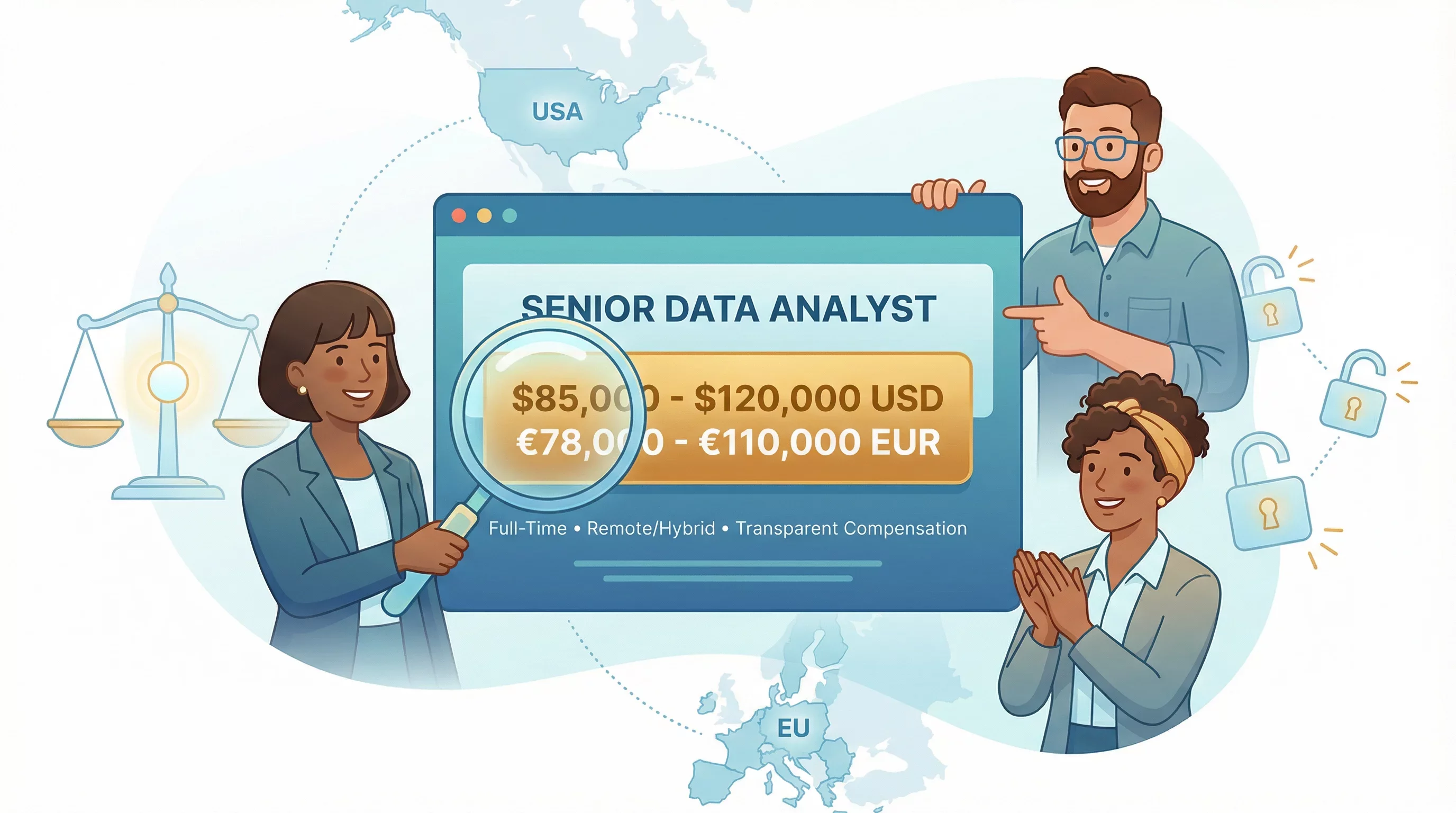
If you have ever applied for a job and seen "salary: competitive" where the actual number should be, you know the frustration. You spend hours on an application, nail the interview, and then discover the pay is nowhere near what you expected.
Here is the good news: salary transparency laws in 2026 are changing the game. Across 17 US states, Washington D.C., and the entire European Union, employers are now required to show you the money, literally, before you even walk through the door.
Whether you are an employee wondering what your colleagues earn, or a job seeker trying to figure out if a role is worth pursuing, this guide breaks down exactly what these laws mean for you.
What Are Salary Transparency Laws? {#definition}
Salary transparency laws are regulations that require employers to disclose compensation information during the hiring process or to current employees. In practice, this usually means publishing a salary range (minimum and maximum pay) in job postings, sharing it upon request, or providing it before an interview takes place.
The idea behind these laws is straightforward: when everyone can see what a job pays, it becomes much harder to underpay people based on their gender, race, or negotiating confidence. Think of it like price tags in a store. You would not buy a pair of shoes without knowing the price first, so why should a job be any different?
The 2026 Landscape: Where Do These Laws Apply?
The salary transparency movement has grown rapidly. Here is where things stand right now:
United States: 17 States and Counting
These states currently require some form of salary disclosure:
Broadest coverage: New York (4+ employees), Vermont (5+ employees), New Jersey (10+ employees)
Mid-size employer focus: California, Washington, Illinois (15+ employees), Massachusetts (25+ employees), Minnesota (30+ employees)
Larger employer requirements: Hawaii (50+ employees)
All employers: Colorado, Connecticut, Nevada, Rhode Island
And here is something important: 10+ additional states including Virginia, Missouri, and Kentucky have active legislation in progress for 2026-2027. This is not slowing down.
European Union: A Continent-Wide Standard
The EU Pay Transparency Directive takes things even further. By June 7, 2026, all 27 EU member states must implement rules that:
Require employers to share salary ranges before the interview
Ban salary history questions (employers cannot ask what you earned before)
Make it illegal to include pay secrecy clauses in contracts
Require gender pay gap reporting for companies with 150+ employees
If you work in Europe or for a European company, these changes affect you directly.
If You Are a Job Seeker: How to Use Transparency to Your Advantage
This is where it gets practical. Salary transparency does not just mean you can see numbers. It means you can make smarter decisions at every stage of your search.
1. Filter by Fit Before You Apply
With salary ranges visible in job postings, you can quickly evaluate whether a position aligns with your financial needs. No more discovering in the third interview round that the role pays 30% less than you expected.
What to look for: Ranges that are specific and reasonable. A posting showing "$85,000 - $110,000" is useful. One showing "$40,000 - $200,000" is likely not complying in good faith, and you might want to think twice about that employer's transparency culture.
2. Benchmark Your Value
When multiple companies in your industry post ranges for similar roles, you build a picture of what the market actually pays. This is powerful data for negotiation.
Practical tip: Before any interview, search for 3-5 similar roles in the same state. Note the ranges. You now have market evidence, not just a gut feeling, to back up your salary expectations.
3. Ask the Right Questions
In states where disclosure is required upon request (Connecticut, Rhode Island), do not be shy about asking. It is your legal right. Try: "Could you share the salary range for this position? I want to make sure we are aligned before we both invest more time."
4. Watch for Remote Work Jurisdiction
Here is something many people miss: if a remote role can be performed from a transparency state, that state's rules apply, even if the company is headquartered elsewhere. A Texas-based company hiring a remote worker who could work from California must comply with California's salary disclosure requirements.
If You Are an Employee: Your Rights Under the New Laws
Pay transparency is not just for people looking for new jobs. If you are already employed, these laws give you new tools too.
You Can Talk About Your Pay
Thanks to Pay Secrecy Prohibition, employers can no longer prevent you from discussing compensation with your colleagues. In many states and across the EU, any contract clause that says "you cannot discuss your salary" is unenforceable. You will not face retaliation for having these conversations.
Why does this matter? Because informal pay conversations are often how employees first discover they are being underpaid relative to peers in similar roles.
You Can Request Pay Data
Under the EU Directive, employees have the right to request information about their individual pay and the average pay, broken down by gender, for workers doing equal work. This is a significant shift. You no longer need to rely on rumors or Glassdoor estimates. You can ask your employer directly and they must respond.
Internal Postings Must Show Ranges Too
Several states now require that internal job postings for promotions and transfers include salary ranges, just like external postings. This means you can evaluate internal opportunities with the same transparency you would expect when job searching externally.
The Pay Equity Angle: Why Reporting Matters
Beyond disclosure, Pay Equity Reporting requirements are pushing employers to actually fix pay gaps, not just show ranges.
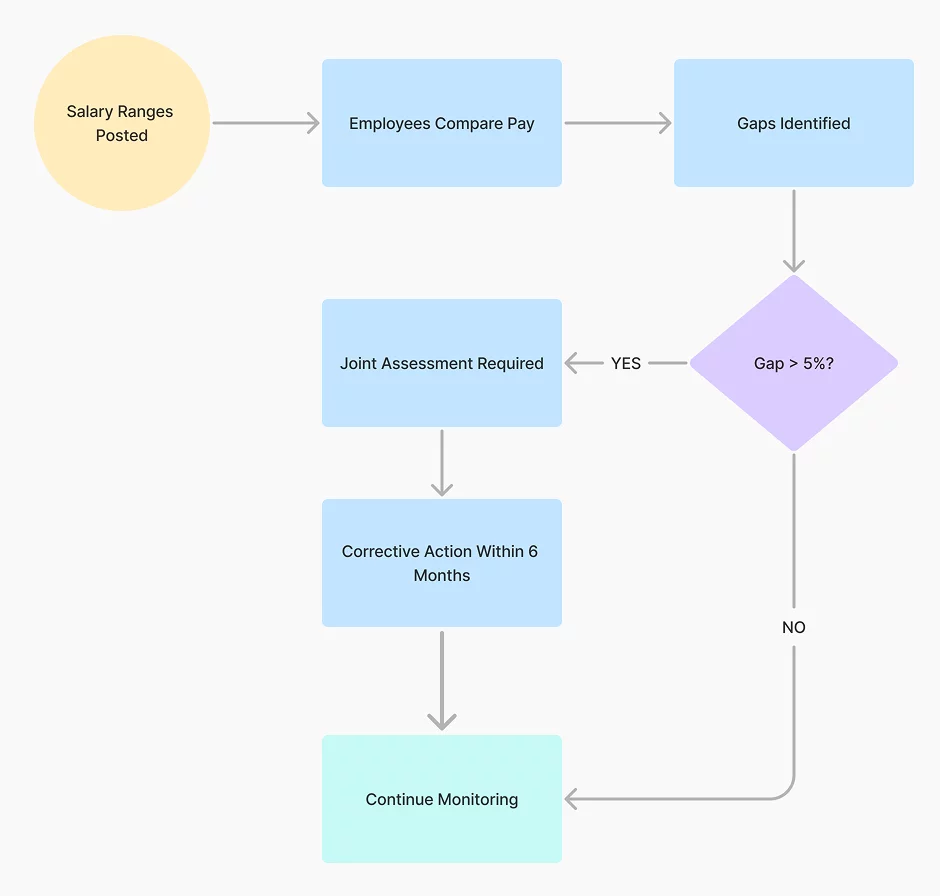
In the EU, if a company's gender pay gap exceeds 5% in any job category and cannot be justified by objective factors like experience or education, the employer must:
Conduct a joint assessment with employee representatives
Identify the root causes of the gap
Implement corrective measures within six months
In the US, states like California, Illinois, and Massachusetts now require employers to submit detailed pay data to state agencies, enabling government enforcement at scale.
Common Mistakes to Avoid
Mistake 1: Assuming transparency laws do not apply to you
If you work remotely, your employer may be subject to transparency laws in the state where you perform work, even if neither of you realized it. Check the laws in your state.
Mistake 2: Ignoring wide salary ranges
A range of "$50,000 - $150,000" is technically compliant but practically useless. If you see this, ask the employer where in the range this specific role falls and what factors determine placement. A good employer will explain their compensation structure.
Mistake 3: Not using publicly available data
With so many companies now required to post ranges, there is more salary data available than ever. Use it to benchmark before you accept an offer or ask for a raise.
Frequently Asked Questions
Not yet. Requirements vary by state and depend on employer size. Colorado and Connecticut require all employers to disclose, while states like California and Illinois set the threshold at 15+ employees. Check your state's specific law.
No. In most US states and across the entire EU, your right to discuss compensation is legally protected. Any retaliation for salary discussions is illegal. If you face pushback, document it and contact your state labor agency.
You can report it. Most state labor departments have online complaint forms. Some states, like Washington, offer employers a temporary cure period to fix non-compliant postings before penalties apply.
If a remote job can be performed from a state with transparency requirements, those requirements apply. This means a remote posting targeting candidates nationwide may need to comply with multiple state laws simultaneously.
The EU Directive requires all 27 EU member states to implement salary transparency rules by June 2026. If you work for an EU-based company or are job seeking in Europe, you will benefit from pre-interview salary disclosure, salary history bans, and the right to request gender-based pay data from your employer.
What Comes Next
Salary transparency is not a passing trend. With more states introducing legislation, the EU implementing its Directive, and enforcement shifting from warnings to real penalties, the direction is clear: pay information is becoming a worker's right, not an employer's secret.
Whether you are searching for your next role or evaluating your current one, the data is increasingly on your side. Use it.
Your next step: Look up the specific pay transparency law in your state or country. Know what your employer is required to share, and do not hesitate to ask for it.
External Links
Jackson Lewis: Navigating 2026 Pay Transparency Laws - Comprehensive legal overview
EU Council: Pay Transparency in the EU - Official EU Directive information