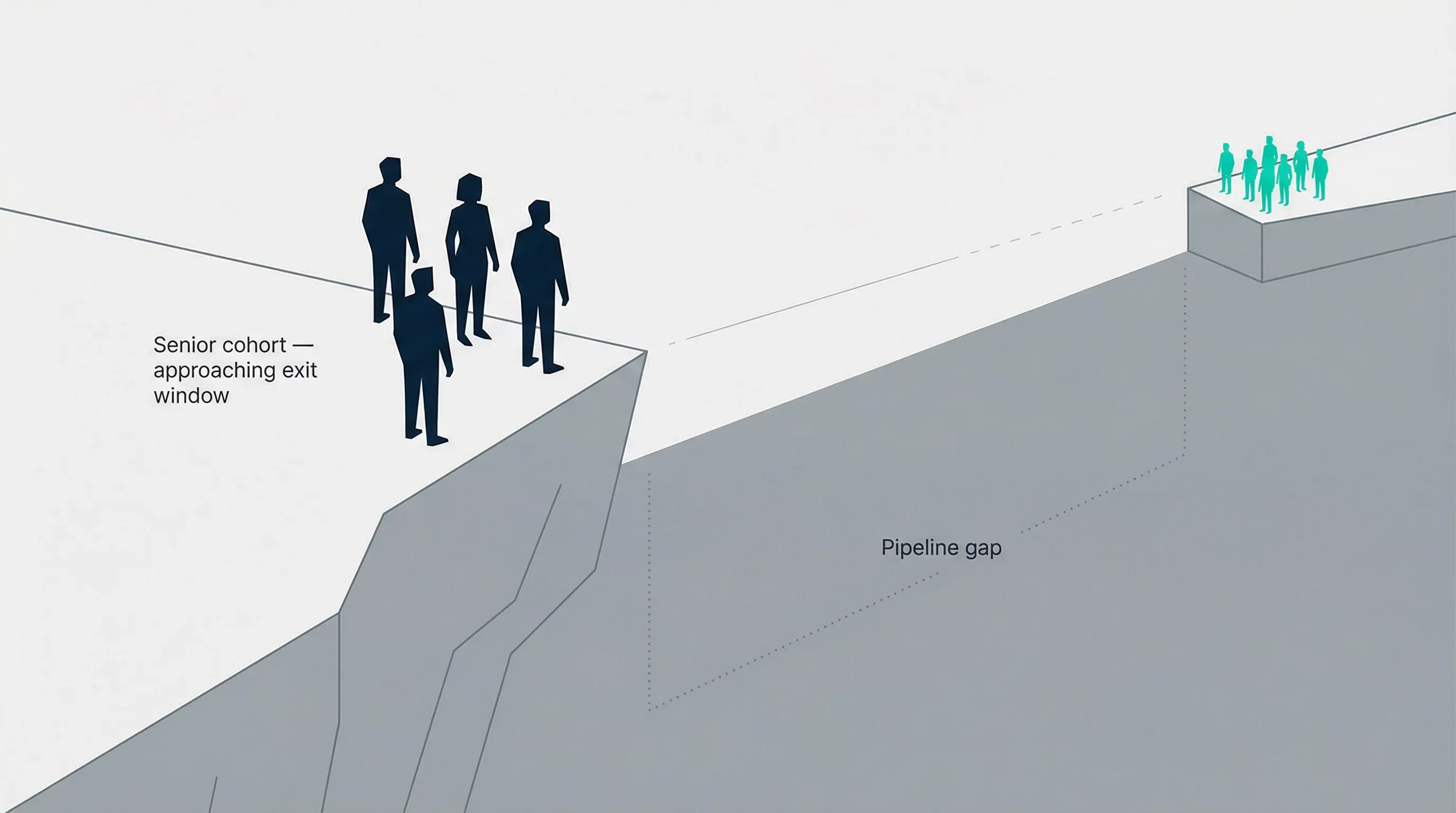
The engineers who built your protocol won't be there forever. What happens when they leave and no one was trained to replace them?
What is the senior cliff in Web3?
The senior cliff is the point at which a company's team becomes so concentrated in senior engineers, with no junior pipeline beneath them, that a single senior exit creates a cascading failure. Velocity drops. Systems become opaque. Incident rates climb. And you're back on the job market trying to backfill institutional knowledge with someone who has never seen your codebase.
Here's why Web3 is particularly exposed right now.
The first generation of blockchain and smart contract engineers is 8–10 years into their careers. The engineers who built Ethereum's core infrastructure, the earliest DeFi protocols, the original ZK proof systems. They're at the natural inflection point where senior engineers start leaving. Career pivots. Retirement. Burnout. Moves into adjacent fields like AI infrastructure or venture.
At the same time, the 2022–2024 bear market triggered rounds of hiring freezes and layoffs that disproportionately cut junior and mid-level roles. Coinbase cut 20%. Binance cut 30%. Kraken cut 15%. The pattern across the industry: preserve senior headcount, eliminate the pipeline.
So now we have teams that are more senior-heavy than ever, with a cohort of seniors approaching their exit window, and minimal junior talent in development to absorb their knowledge before they leave.
That's the clock.
Why the standard response is wrong
When you raise this with engineering leadership, you usually get one of three responses:
"We can't afford to train juniors right now."
This calculates training cost but ignores knowledge loss cost. More on the math in a minute.
"We'll hire externally when we need to."
The problem: you can't hire institutional knowledge. The person who designed your consensus mechanism, who knows every edge case in your smart contract architecture, who understands why certain protocol decisions were made in 2019. That knowledge doesn't come with a recruiter. When they leave, it leaves with them.
"We'll write better documentation."
Documentation captures what systems do. It almost never captures why they were built the way they were, what the failed approaches looked like, or what the undocumented constraints are. Junior engineers who work alongside senior ones absorb tacit knowledge that documentation cannot encode.
All three responses solve for the visible cost (junior salary and manager time) while ignoring the invisible cost (knowledge loss when seniors exit). That's the accounting error at the core of the problem.
The math on knowledge loss
Let me put numbers on what you're optimizing away from.
The junior pipeline investment is significantly cheaper than the knowledge loss event it prevents.
SHRM's research on senior technical employee replacement pegs the direct cost at 1.5–2× annual salary: recruitment fees, interviews, background checks, and the productivity dip during the replacement's ramp-up period.
But for senior engineers who carry significant institutional knowledge, the real cost is higher. Consensys published internal team metrics after senior exits in 2023 showing project velocity drops of 35–50% for 6–12 months on teams that lost key engineers without succession candidates in place. For a team of 8 earning an average of €100K each, a 40% productivity drop for 9 months costs roughly €240K in lost output before you've spent a single euro on recruitment.
Add the recruitment premium for a senior-level replacement (€20–30K in fees, minimum), the ramp time for someone without institutional context (another 6–12 months before they're operating at full effectiveness), and you're looking at a total cost of 3–4× annual salary for a senior engineer exit without a trained successor.
Now contrast that with the cost of having a junior in development:
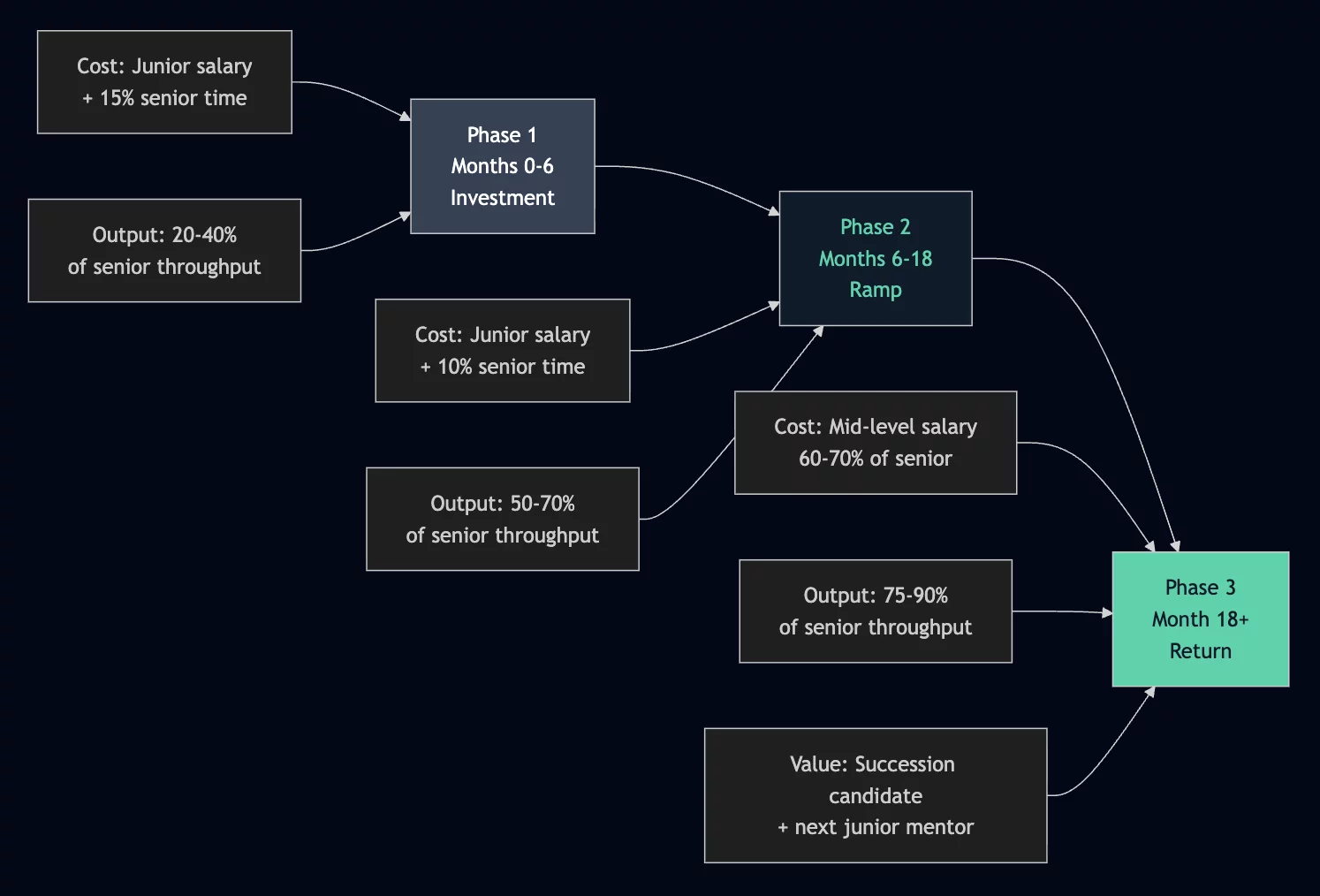
Junior salary: approximately 50–60% of a senior
Senior mentorship overhead: approximately 15–20% of one senior's time during months 1–6
Total first-year cost: roughly 30–40% of one senior salary
At month 18, that junior is operating at 70–80% of a senior's output, can take ownership of systems with guidance, and has absorbed institutional knowledge that can't be purchased on the open market.
The ROI isn't close. The junior pipeline investment is significantly cheaper than the knowledge loss event it prevents.
How to build a junior pipeline in Web3. A 5-steps framework.
Here's how to build a sustainable pipeline even in a lean environment:
Step 1: Map your single points of failure
Before you hire anyone, identify which senior engineers on your team are carrying disproportionate institutional knowledge. Who are the people where, if they gave you two weeks' notice tomorrow, you would have a genuine crisis? That list is your succession risk map. Prioritize building junior candidates in those areas first.
Step 2: Define your ideal junior profile for Web3
Not every junior hire is equally valuable in a crypto context. Look for: strong fundamentals in computer science and security reasoning, demonstrated curiosity about blockchain architecture (open source contributions, protocol research, hackathon projects), and comfort with asynchronous work in distributed environments. You're looking for someone who will absorb your specific institutional knowledge, not just someone who can write Solidity from tutorials.
Step 3: Structure the first 90 days deliberately
The single biggest ROI killer in junior hiring is unstructured onboarding. The junior spends six months figuring out what they're supposed to be doing. Prevent this: define a specific system or protocol subsystem they will own by month 6, pair them with the senior whose knowledge is at highest exit risk, and give them explicit documentation and PR review responsibilities in weeks 1–4. Active absorption from day one.
Step 4: Create knowledge transfer accountability
Pair junior ownership of documentation and architectural decision records (ADRs) with senior sign-off. The junior writes the documentation; the senior validates it. This forces knowledge externalization in the process of developing the junior. You get both a succession candidate and a better-documented codebase.
Step 5: Build a junior-to-senior ratio target into headcount planning
The sustainable range is approximately 1.5:1 to 2.5:1 junior-to-senior. Below 1:3 (fewer than one junior per three seniors) is cliff territory. Put this in your engineering org health metrics. Review it quarterly. When you're below the threshold, it's a red flag for engineering leadership, not just HR.
What good looks like: documented cases
Ethereum Foundation has maintained a junior developer and fellowship program through every market cycle, bull and bear. Their contributor retention rate is significantly above industry average. The mechanism is simple: by the time senior contributors are in their exit window, multiple successors have been in development for years. Transitions are managed, not emergencies.
Protocol Labs published data showing teams with 2:1 junior-to-senior ratios shipped faster during periods of senior turnover than teams with inverted ratios. Not because juniors are faster, but because knowledge was distributed across the team instead of concentrated in departing individuals.
The difference is measurable. Companies that kept junior hiring steady through the bear market are in meaningfully better succession positions heading into the next bull cycle than the ones that paused it.
The question isn't whether you can afford to hire juniors.
It's whether you can afford not to.
The urgency is now, not later
Here's the thing about the senior cliff: by the time it becomes visible, it's already too late to fix it on the timeline that matters.
A junior hired today is 18–24 months away from operating effectively enough to be a succession candidate for a senior role. If your senior engineers are in their exit window in 2027–2028 (a reasonable projection given tenure profiles), you need the pipeline built now.
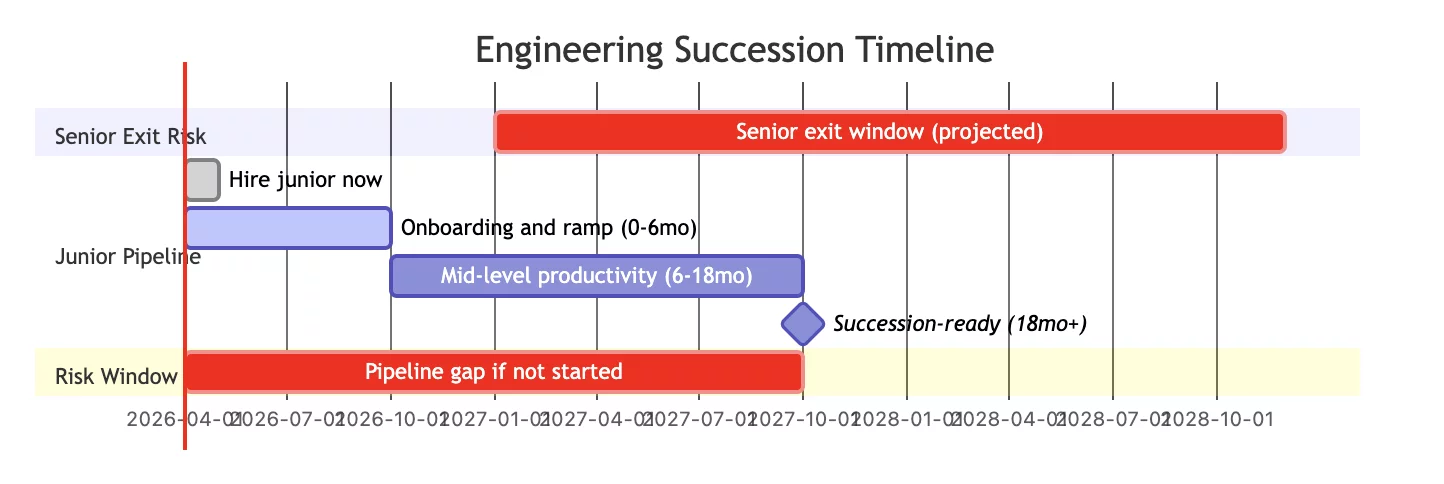
Waiting until a key senior gives notice to start thinking about succession means you spend 3–4× more on the recovery than the prevention would have cost. And you lose knowledge that cannot be recovered with money.
The argument "we can't afford junior hiring right now" only survives if you don't account for the cost of not doing it. When you run the full model, training cost vs. knowledge loss cost vs. emergency replacement cost, the math resolves clearly in favor of the pipeline investment.
The question isn't whether you can afford to hire juniors.
It's whether you can afford not to.
FAQ: Junior Hiring in Web3
The knowledge transfer and succession benefit of junior hiring is time-dependent. Every month without a pipeline candidate in development is a month closer to the knowledge cliff when seniors exit. The bear market argument for pausing junior hiring optimizes for short-term cost at the expense of a long-term organizational risk that is significantly more expensive to remediate. The correct framing is: hiring juniors in a slow period is cheaper than hiring seniors in an emergency.
Retention of junior developers correlates strongly with: structured mentorship (they feel they're learning), clear progression criteria (they know what "getting better" looks like), and meaningful ownership (they're responsible for something real, not just grunt work). Junior churn in Web3 is often a mentorship quality problem, not a compensation problem.
The sustainable target range is approximately 1.5:1 to 2.5:1: enough junior and mid-level engineers to provide succession coverage without overloading senior mentorship capacity. Teams below 1:3 (junior:senior) should treat this as a risk metric requiring active intervention in the next headcount cycle.
Build the cost model over 18–24 months, not 90 days. Include: training cost (junior salary + 15% senior time overhead), ramp output value (20–40% of senior throughput by month 6), and avoided knowledge loss cost (1.5–4× annual salary per senior exit without succession). The 18-month ROI is typically 2–3× the training investment. Present it as risk mitigation infrastructure, not headcount.
The clock is ticking
The engineers who built Web3's first wave are approaching their natural exit window. The companies that maintained junior pipelines through the bear market are positioned for smooth transitions. The companies that didn't are building toward a knowledge cliff that no amount of recruiting budget will cleanly solve.
The five-step framework above is executable this quarter. The mapping exercise takes a day. The junior profile definition takes a week. The structured onboarding plan takes two weeks to build.
The knowledge cliff takes years to create and years to recover from.
Start now.